




Walter Lucken IV
October 27, 2025
On Saturday, October 25, 2025, Runner Magazine presented a lecture by Walter Lucken IV followed by a Q & A moderated by Eleanor Aro and Emily Jones of Michigan Student Power Alliance. The talk took place in the Clara Stanton Jones Friends Auditorium at the main branch of the Detroit Public Library. The event addressed the concerns originally expressed by Lauren Berlant in the text ‘68 or Something. Walter Lucken, Eleanor Aro, Emily Jones, and audience members asked what we can learn by moving beyond the memory of 1968 and releasing our attachment to a triumphant past? The lecture and following discussion also highlighted how idealization of the leaders of these previous protest movements comes to serve a conservative function, limiting the range of political speech and confining campus activism to that which conserves the idea of the university itself, and defends it from the excesses of politics.
.jpg "AgainstTheArchive.WalterLuckenIV")
A scene from the 1968 Columbia University student protests. Former Barnard student and Students for a Democratic Society (S.D.S.) member Nancy Biberman notes, “Two strands of anger and disgust converged: what the university was doing to aid the war effort, and what [it] was doing that was racist in our neighborhood.” Photo by Steve Schapiro
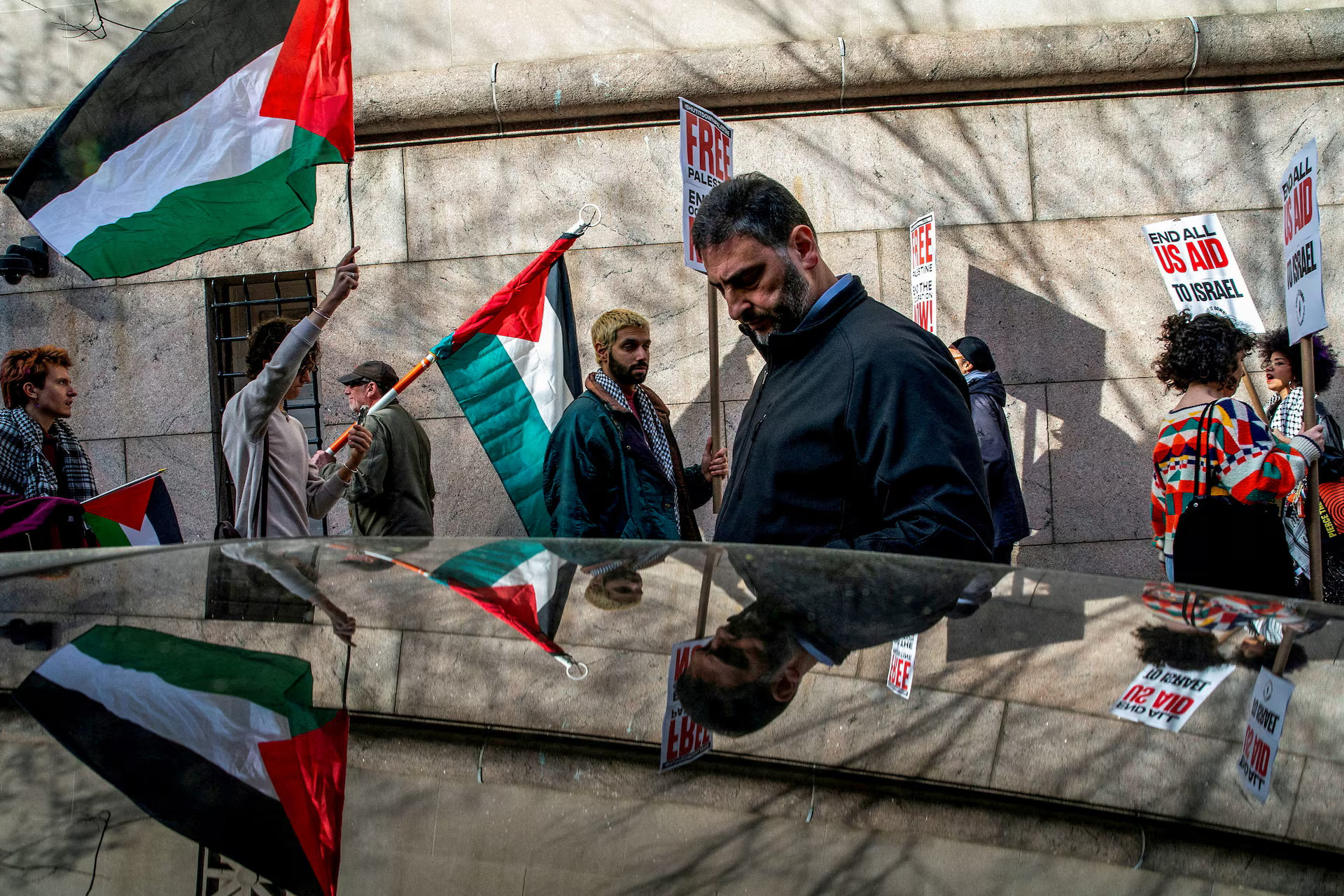
A man passes by as demonstrators attend a protest outside Columbia University, in New York City, April 23. Photo by Eduardo Munoz, courtesy of REUTERS
Published in the 90s, Lauren Berlant’s ’68 or Something expressed concern that the biggest threat to progressive politics was a rejection of past protest movements and the idea that protest itself was “dated” or out of vogue. Today however, the meaning of 1968 era protests—which marked a significant rise in left-wing politics, anti-war sentiment and civil rights—has actually been almost fully absorbed by the university. Rather than a dismissal or condemnation of the protests of the past, we see a flurry of official recognitions and commemorations of past protests on our campuses. This leads to a phenomenon where an institutionally sanctioned celebration of historic student activism suppresses campus protests happening today. We are seeing the same institutions that celebrate their own histories of student protest wielding state violence and repression against protesting students, producing disorienting feelings of shock, abandonment, and disillusionment.
- Walter Lucken IV
Good afternoon everyone. I’m glad to be back at the Detroit Public Library, an institution to which I am deeply indebted both literally and figuratively. Today my hope is to talk through some of my thoughts on the relationship between our collective memory of past social movements and the challenges we face today. For those who don’t know, I completed my doctorate across the street in 2023 and moved to New York to teach at CUNY. The last two years have been very difficult. We have all had to make a lot of very hard decisions and I myself have often been at a loss for what to do, and decided to just hang onto my values. Of course, a lot of my values come from here and our history. One thing I come back to again and again is our history of solidarity with the struggle against apartheid, so I’d like to start there.
Whenever I talk about my relationship to the struggle against apartheid in South Africa, I like to touch on two connected images. The first more or less boils down to a moment in 2006 at a family Christmas gathering in Mt Clemens, not far from here, where a family elder pointed to a framed portrait of Nelson Mandela on the wall and asked a little cousin “who is that man”. My cousin exclaimed, loudly and proudly, that the man was indeed Nelson Mandela, to the whole family’s applause. The second is the famous photograph of Mandela in a matching Pistons hat and jacket marking the occasion of his 1990 visit to Detroit following his release from Robben Island. I used this picture as the visual touchstone to tie together my research presentation when I interviewed at Queens College for my current position.
Apartheid fell in 1994, 4 years after Mandela came here for a visit. I was 4 years old, my younger brother was born that same year at Providence Hospital as I was. Today he’s 31. All across South Africa lives a generation his age or younger known as the “Born Frees”, who never knew apartheid and have spent their entire lifetime in its aftermath. Around the same age are the “Ceasefire Generation”, who have yet to see a united Ireland but have lived their lives in the shadow of the violence of the Troubles, never experiencing it themselves. Their counterparts amongst Palestinians are known as the “Oslo Generation”, born amidst the promise of the peace process in the wake of the First Intifada, who have lived their lives in a time of escalated violence, constricting political possibilities, and now genocide in Gaza in the shadow of the 1993 Oslo Accords. Back in Detroit, my brother and I are “Millenials”, lacking a historical event to mark our life experience. As our generation comes of age and begins to make our mark on politics as leaders and commentators, this phenomenon creates something of an aporia in our understanding of ourselves.
This conundrum, the demand for the post hoc reconstruction of our own historical conditions, can serve as a generative moment if we can allow this to happen. If I may, I’d like to attempt to do so this afternoon. Since the 2008 financial collapse, America has changed dramatically. A lot of norms we took for granted have fallen by the wayside, giving way to new rules and expectations. Most of the lasting changes have been negative, and a lot of the positive developments have been reversed. In Trump’s second term, he’s met nowhere near the level of institutional resistance he faced in 2017. There seem to be very few meaningful limits to what his administration can do. This leaves us in the lurch, aware that the guardrails are off but unsure how to respond. As often happens in history, our society has changed faster than our ideas and means of understanding the changes can evolve. This creates a feeling of disorientation.
The likely next mayor of New York City is Zohran Mamdani, a Uganda-born democratic socialist who has vowed to arrest Benjamin Netanyahu if he steps foot in New York. Following the assasination of Turning Point USA leader Charlie Kirk, a consensus is slowly emerging that the most prominent young voice on the right is Nicholas J Fuentes, a white nationalist who has denied the Holocaust on numerous occasions and believes that women should be denied the right to vote. Socialism, as a political orientation and set of concepts, enjoys majority support with Americans my age or younger according to most polls. These developments would be unthinkable in the 1990s, and the shock of such a tremendous change in American politics has created knock on effects of its own, ranging from “Trump Derangement Syndrome” to “cancel culture”. Millions around the world have been alternately shocked by the unthinkable brutality of the horrors in Gaza and desensitized to them, while America has quietly accepted that regular school shootings are part of the background noise of our everyday lives.
Underlying the shocks of the present are an attendant collapse of the norms and guardrails we might use to stabilize our democracy amidst the interlocking global and national crises which gesture toward its collapse. Nowhere is this more obvious than on our university campuses.
The prevailing narrative from both sides of the political spectrum is that students learn some basic set of ideas about the world and themselves from their instructors, and campus protests and general unrest are a downstream consequence of these concepts. Where the sides differ is whether this is good or bad, whether this process threatens the edifice of our political culture or is our best hope at maintaining it. Where they agree is their assumption that our political culture is created or maintained by what happens on campus. I don’t think that this assumption is supported by evidence, nor do I think it’s helpful or useful. What I have heard again and again from colleagues and relatives of an older generation is that the campus protests of their college years never reached the level of intensity they’ve seen from the Palestine protests and encampments in the last two years. The specific counter example I am presented with again and again, for generational reasons, is 1980s demands on universities to economically divest from apartheid South Africa. The right wing, of course, does not differentiate at all between any student protest movements from the 1960s onward, regarding all of them as part of a larger cultural Marxist conspiracy to undermine America. Thus, we get campaigns against DEI, affirmative action, abortion rights, and other progressive victories. From a very specific liberal perspective, however, there is something new and especially threatening or unsettling about the last few years of protest. For them, something has changed while they weren’t looking, the young have a harder edge and lost their willingness to compromise, dialog, come to an understanding, and so on.
My peers usually argue that this is a false memory of the 1980s, and that the protests of the past are just as disruptive. In addition to that, they usually chalk this perception up to residual sympathy for Israel and Zionism amongst our elders, anti-Palestinian racism, and even simply whiteness or white fragility. I don’t dispute that the above are true or important factors, but in the end I am a scholar or teacher of rhetoric and therefore I do not think it is useful to point out that a perception is factually false or assume that it is motivated by some form of bias or personal feelings that distort an interlocutor’s view of the situation. Put simply, people think what they think and act on what they think, and we can learn much more from viewpoints we disagree with just for the simple fact that another person seeing the same thing differently tells us something about the world we live in. We can in fact learn a great deal from senior colleagues and neighbors’ “concerns” about the protests. We can learn perhaps even more from the nuances of when and where senior faculty and the political establishment have supported the protests, and why.
Anecdotally, and hopefully somebody can let me know if this was not the case elsewhere, I noticed a surge in sympathy for student protesters and their actions at the precise moment when state violence began to be used against the Gaza solidarity encampments across the country. Group chats swelled with colleagues who arrived to the conversation in full support of protesting students. I began to hear a great deal about free speech, academic freedom, and the campus protest as an important rite of passage for America’s youth which must not be interfered with or annulled by the excess of outside political pressure. It seemed that the entrance of police and SWAT teams to dismantle the encampments was a violation of the sanctity of the university itself, that peaceful and nonviolent protest was a basic human right enjoyed by every student. I will admit, I was deeply upset by the violence used against students in New York and elsewhere, but not surprised or shocked. Honestly I was confused why anyone was surprised, given that at that time every university in Gaza had been destroyed and the Gaza Ministry of Health had largely lost capacity to count casualties, meaning that the more than 35,000 casualties reported at that time were likely an undercount. I simmered with anger at the idea that anyone could be incredulous in the face of any violence anywhere in the world after what we had seen. Were the students of Gaza’s universities not also students? Was Refaat Alareer, a Palestinian public intellectual killed by Israel in an airstrike, not an English professor? How dare we be shocked that we too might see our students arrested or beaten by the police. Of course that could happen. How could we act like anything was off the table? The guardrails are off.
From there, discussions of academic freedom and free speech crept in further and further. I began to hear discussions about press freedom amidst the American media’s internal purges of its workers and retaliations against journalists for covering the events in Palestine at all, to say nothing of the reprisals against those which took an explicit stance in support of Palestinians. In this version of the story, Israel’s campaign of genocide and the ways in which our legacy institutions were complicit represent a threat to the integrity of the institutions themselves, whether journalism, academia, the arts, literature, and so on. I fully agree that the last two years have destroyed the credibility of many if not most of our institutions. I became concerned, however, when I noticed that this discussion was displacing any mention of what was happening on the ground in Gaza. Even more troublesome was the disproportionate attention paid to the repression facing our colleagues in United States civil society as compared to the unending murders of Palestinian journalists and teachers by Israel.
It would be simple, and probably accurate, to attribute this dynamic to Western arrogance, anti-Palestinian racism, and a feeling of invincibility that many of us still feel even in the face of rising political violence and war around the world. It is easy for us to feel like we ourselves are somehow exempt from the horrors we see on global news, and indeed the news itself and many aspects of our political culture are designed to produce or elicit this feeling. As a collective, if we felt that we were as vulnerable to the actions of the powerful as those living in Palestine, Yemen, south Lebanon, Sudan, or the Democratic Republic of the Congo, we might make different choices in our everyday lives and in our capacity as political agents. Again, though, I don’t know that this is the whole story. Maybe I’m wrong, and for my own sanity I’ve had to reach for an explanation of how an otherwise reasonable person could totally fail to understand things that I consider self-evident. I have no doubt that I have been on the other side of that equation in the past, maybe I am today and an audience question will expose it in a bit. For now, I will hypothesize that there is a deeper reason for this collapse of understanding in such a pivotal historical moment, and that there is indeed a generational element for it.
For this purpose, I’ll return to South Africa’s “Born Frees”, the generation who grew up in the aftermath or afterlife of apartheid. One of my favorite documentaries which I show to my students every year is 2012’s “Dear Mandela”, which centers on 3 members of the shack dwellers movement, known in Zulu as Abahlali baseMjondolo. The film centers on Mandela’s still unfulfilled promise to house every person in South Africa, and this promise’s codification in the 1996 constitution. As the narrative unfolds, the 3 friends eventually make their way to South Africa’s constitutional court and successfully challenge legislation aimed at demolishing an informal settlement. Midway through, one of the young activists leads a chant denouncing every major political party in South Africa. When he says “Down with the ANC”, however, the crowd falls silent and the elders present in the crowd glare at him with disapproval. Moments later, another of the 3 comes out to smooth the situation over, asking for grace and trying to explain the context of why the group is critical of the ANC. Implicit in the scene is the attachment of the older comrades to the ANC as Mandela’s party and the group which toppled apartheid and brought democracy to South Africa. For the Born Frees, the ANC is the political establishment against which they have been struggling, and absent the experience of apartheid they don’t find the idea of sticking with the ANC compelling.
I apologize for the crudeness of this analogy, but I think this is what has happened with our legacy institutions, the broader political establishment, the Democratic Party, and even in many ways the leadership of the broader progressive left. I think when I criticize the Democrats a lot of older people hear me criticizing the civil rights movement, labor unions, Roe v Wade, same sex marriage, affirmative action, and other hard won progressive victories across the 20th century. Indeed, for me it is easy to dismiss the Democratic Party following the 2024 election and especially in the broader context of the policies it has pursued in lockstep with the GOP throughout our lives, many of which have brought economic immiseration to our communities, expanded mass incarceration, exported carnage to the rest of the world, and essentially disrupted any notion of futurity for someone my age. The utter contempt with which the party has treated its base recently, especially around economic issues and the genocide in Gaza, speaks for itself. I didn’t vote for Democrats in 2024 because my body physically recoiled from the idea of putting my black spot next to Harris after how the party behaved during the election. I’ve never felt particularly well served by the ruling political order in the US, nor have my peers. I still voted though, mostly based on the difference between the parties on abortion rights and health care. This time, though, it wasn’t my decision to make. The Democrats let me know they didn’t want my vote and they especially sent this message to our Arab and Muslim neighbors here in Detroit, I know I don’t have to provide examples. I had no right to vote for Harris after she was part of an administration responsible for what we saw in Gaza. Instead, I participated in a local write-in campaign in memory of Hind Rajab, a 5 year old Palestinian girl killed by Israeli soldiers.
At the same time, in the months leading up to the election it became clear to me that others had compelling reasons for feeling differently. Sure, there was a great deal of emotional blackmail about the potential consequences of a second Trump administration, laced with some nasty implications that anybody who boycotted the election over Gaza was a performative activist, arrogant, making a niche issue their own personal moral crusade, selfish, or some kind of narcissist. If I wanted to I suppose I could interpret any criticism of my choice in bad faith and run it all together with those accusations. It would also be easy to point out that Trump has threatened to imprison “antifa” members as well which means that me and anybody else involved in organized leftism also has a compelling reason to fear his return to the White House. What would the point of that be though? I would be guilty of what I’ve been accused of: moral arrogance and a lack of interest in the other perspective. Most importantly, the magnitude of Trump’s threat to our lives is real and it requires us to work together. This meant I had to do two things: understand the other side in good faith, and put my argument together in a way that they might be able to understand me in good faith.
What I came up with is pretty simple: the guardrails are off already and the political order that a lot of us feel varying levels of attachment to is coming down. The lack of an Oslo Accords or 1996 Constitution to point to exacerbates the feeling of a long standing political order collapsing all around us with no single event or inflection point to mark it by. Things become more and more unpredictable every year and explanations are more and more elusive. Personally I think that when Obama failed to follow through on the promise of his campaign that was the end. Biden won in 2020 because the left and the establishment were on the same side and everyone more or less worked together. We couldn’t do that in 2024 because of the Democrats supporting genocide in Gaza, full stop. It’s that simple. My own opinions aside, the Democrats did not have a compelling moral argument in 2024 as demonstrated by the result. And let me be clear, I am a person who as a young man was actually de radicalized by Obama’s 2008 campaign. Prior to his announcement I had already decided, as a teenager, that voting in United States elections was pointless. Like so many others though, I felt that Obama addressed my peers and I with respect, and I felt that I was a part of what he was doing. This meant in practice that I spent a great deal of my time in college defending the Obama administration in debates with conservative students. At the time it was clear to me that while my own personal viewpoints were far to Obama’s left and I was perpetually disappointed with his decisions, attacks on Obama were attacks on us. I was in some way a part of what he was doing, and instinctively I recognized that I too would be targeted in the backlash against Obama’s administration, as would everyone and everything I love. I did not feel the same way about Bernie Sanders. To this day when Obama gets it wrong, which happens quite often, it stings much more than when Sanders says something I don’t like. The Democrats have not spoken to us in the same way since.
As for our own speech, even making an objective assessment of the situation in Palestine based on academic sources can be tremendously controversial, which is why my peers and I are losing our attachment to the idea of academic freedom. In a lot of workplaces in America, you can be fired for suggesting that a discussion of Israel’s policies and conduct should be based on credible academic sources and that one ought to use references and statistics produced by international independent bodies like NGOs and the United Nations. Police investigations have been initiated based on this suggestion, and many have lost their jobs. I’ve seen colleagues doxxed by sitting members of the United States Congress for discussing disinformation and inconsistencies in the official narrative of events in Palestine. This has shocked a lot of people, producing a sense of disorientation that naturally leads many to try to chart a path back to stability, to get our guardrails back. They are not coming back, at least not the old ones.
For an example, let’s return to Ireland and the ceasefire babies. The international representatives of the “Ceasefire Generation” at this time are the West Belfast rappers Kneecap, who have been outspoken about the events in Gaza and raised money for humanitarian aid. They’ve also been dropped from festivals and other opportunities for their support of Palestine. The most severe reaction they’ve received is of course the prosecution of Kneecap member Liam O’Hanna for allegedly violating the United Kingdom’s Terrorism Act by displaying a Hezbollah flag during a performance in London. Ironically, the Terrorism Act was originally passed in the context of the ceasefire in the north of Ireland and the Good Friday Agreement, and superseded the 1989 Prevention of Terrorism Act. The 1989 law focused its attention on “proscribed” organizations on both sides of the Troubles, making it illegal to be a member of a proscribed organization, raise money for such an organization, express public support for such an organization, or attend a meeting organized by or addressed by members of that organization. The first groups to be proscribed included the Provisional Irish Republican Army, the Irish National Liberation Army, and numerous Loyalist groups. As of now, the group Palestine Action is proscribed as well, alongside Hamas and Hezbollah, and some have reported being arrested or detained by police for wearing clothes bearing the word “Palestine”.
This situation is immediately foreign to our own political culture in the United States, and based on most interpretations would be forbidden by our Constitution rather explicitly. What we ought to understand, however, is that regardless of its motivations, the Terrorism Act functions as a kind of political guardrail against violence and instability. Trump’s recent declaration that “antifa” are domestic terrorists mark an escalation in the use of state power in this pursuit, but our civil society institutions and non profit industrial complex have essentially served this purpose for decades, marking certain ideas as off limits and pushing certain political affiliations to the margins on both sides of the political spectrum. We could debate whether this is good or bad or whether certain positions ought to be off limits. In so doing though, we must recognize that the use of some kind of force is necessary to make it so, and there must be genuine consequences for these prohibitions to be meaningful. We must also recognize that regardless of its possible merits, this situation has become unsustainable. The guardrails are off in all directions. This principle is revealed by the reactions to Trump’s attacks on universities since his return to the White House and the escalating level of state overreach facing United States higher education. My peers and I are horrified, but not surprised. Primarily because like I said, the murder of Gaza has revealed to the world what many already knew, that whether the guardrails ever really existed to begin with, nobody can seriously deny that they are off now. Who knows what will happen. Part of why a lot of us didn’t vote was the basic recognition that at most a Harris victory would slow this process down and give the dark forces pulling our world towards the brink a couple more years to regroup. What I was initially confused by is the extent to which so many well meaning colleagues fully internalized the media narratives about the protests but were simultaneously appalled by the initial police response and especially by Trump’s actions since he’s been in office.
When I visited the encampments I saw students of all backgrounds and religions sharing meals, prayers, reading groups, and the space itself. Before they came down, I was in the process of organizing a visit where skeptical or even fearful colleagues and relatives could accompany me to an encampment and have an in person discussion with the participating students and understand their motivations and perspective. Whatever we think the university can be such that we defend it in its current state, I saw in the encampments. At the same time, defending the virtue of the encampments at the expense of their ideological goals would not only be a moral mistake but also a profound misunderstanding of the students’ motives. They were not there to defend the university, free speech, academic freedom, civil society, the right to peaceful protest, or any of that. They were there to try to do something to help the people of Gaza. They didn’t need us to defend their right to be there, because when you are doing what is right that’s all the right you need. Anybody I know my age or younger is under no illusion that you can count on the guardrails to protect you if you stand up to oppression. I think this is a lesson that was lost since the 1960s and even in many ways since the 80s and 90s but is returning to the curriculum today.
We saw the first glimpses of this in the Occupy movement, wherein my generation and those slightly older than us came to the realization that following the rules wasn’t going to lead to a stable future. This is a heavy generalization, I recognize. The sense of betrayal is real, however, and it pervades the political consciousness of everyone I know. Obviously for me it primarily relates to earlier generations of progressives, whites especially as I’m white myself. My friends from other communities or cultures have similar feelings relating to whoever their elders are. Our relationship to a position of preservation is much more complex and ambivalent than our relationship to a position of demand or a position of refusal. Especially irksome is what we perceive as a celebration of past protest movements and their victories paired with “concerns” about today’s protests, when from our perspective the movements have almost identical goals and values.
At the same time, the generational narrative is itself something of an over generalization. I recently interviewed Ian Barnard, a senior colleague who took the time to explain some of their experience in apartheid South Africa and how they see the same patterns playing out in the United States today. Across from the building where I teach, Ira Shor’s words are etched in the wall. He is now in his 80s, and all three of us are signatories of an open letter from rhetoricians in support of Palestine circulated in 2023. I don’t actually believe that older generations are less supportive of progressive causes and values than us, I think that our world has changed so fast and so irrevocably that we have at times lost the ability to understand one another. The late Lauren Berlant wrote in the 1990s that their contemporaries had identified an overt focus on politics and social justice as “being 68”, treating any return to the protests of the past with derision and condescension. At that time, some of the major protest movements were not only the aforementioned struggle against apartheid but also the battle against HIV/AIDS and homophobia. Many veterans of those 1980s and 1990s battles have stood alongside us in the last 2 years. Yes, the dynamic I am describing is real, but it does not have to be our destiny. I don’t want to be angry and sit alone feeling morally superior. I got all the mileage I’m gonna get out of that. The circumstances we are in especially demand that we understand each other and work together, as the two sides are becoming clearer and clearer every day. I need everyone to understand that the guardrails are off. Whatever happens next will be because we either made it so or somebody else did. We can’t go backwards regardless, but going forward can look a whole lot different based on our choices. Either we crawl on top of each other and fight over crumbs while the Gaza program is exported worldwide, or we recognize that we have no right to anything that a room full of people in Gaza doesn’t also enjoy. Anyone who can recognize this is part of the solution.
I do not know what is required for there to be a positive future for humanity. In fact, the idea that humanity can use its collective agency to confront the problems it faces is itself a leap of faith. Core to what Ralph Cintron calls “the democratic rhetorics” are a series of assumptions about the capacity of humankind to reason as a collective. Rhetoric, to me, is the art of living together in a political community. We must decide where the boundaries of our political communities will lie. The right has drawn theirs, a strange alliance of global ruling class solidarity with white Christian identity politics in America and right wing nationalism across the world. Of course, this alliance is doomed to be undone by its own contradictions, but not before it creates unimaginable amounts of suffering and chaos. We imagine that Trump’s popular base of support will automatically turn against him when they experience the impacts of his policies. History does not support this conclusion at all, especially when we expand our analysis beyond the borders of the United States. There is always somebody else to blame. If I have any prescription at all, it is exactly that. We must situate ourselves within the roots of the current crisis and recognize that we are not at all exempt from the horrors on our phone screens.
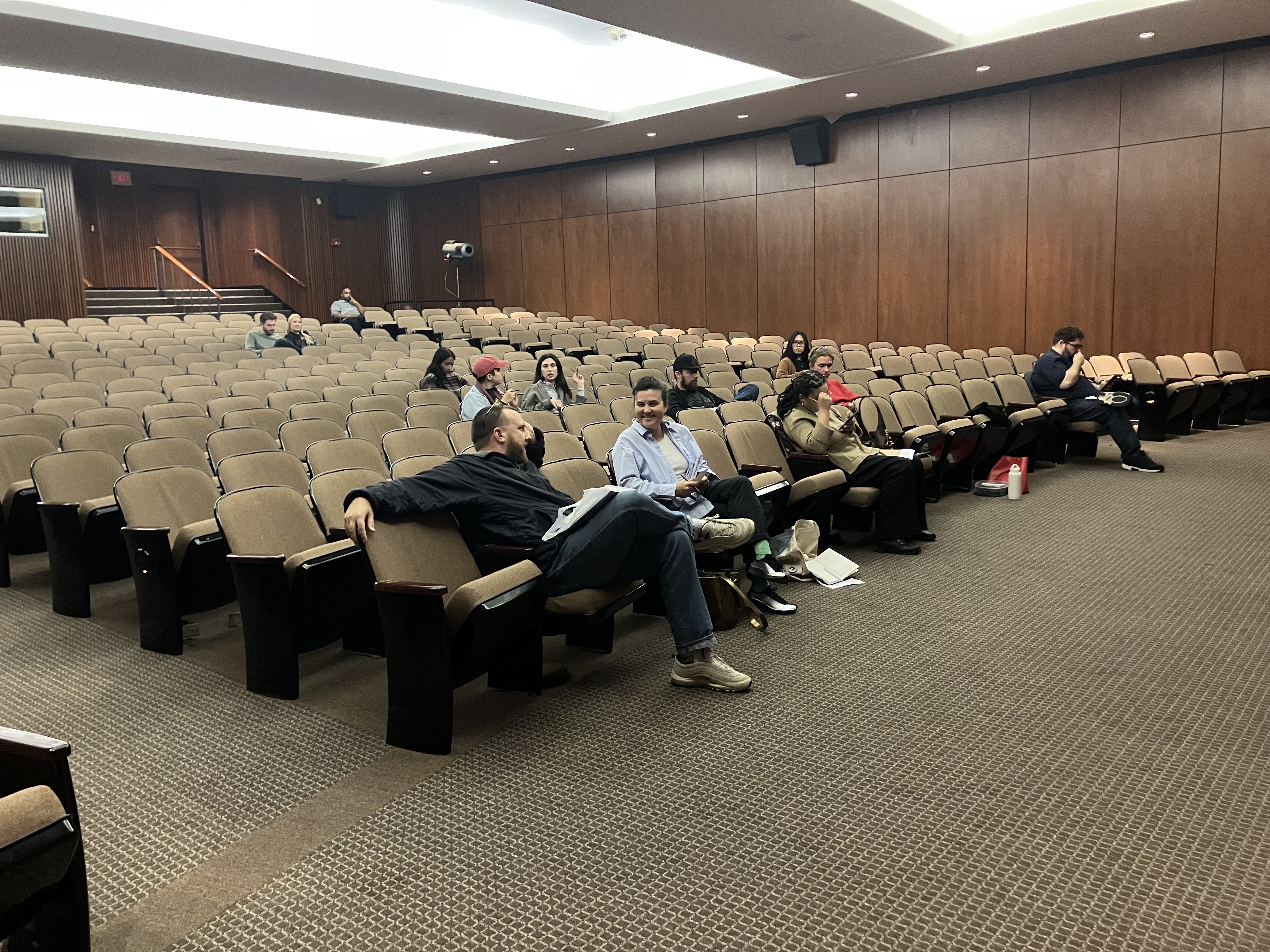
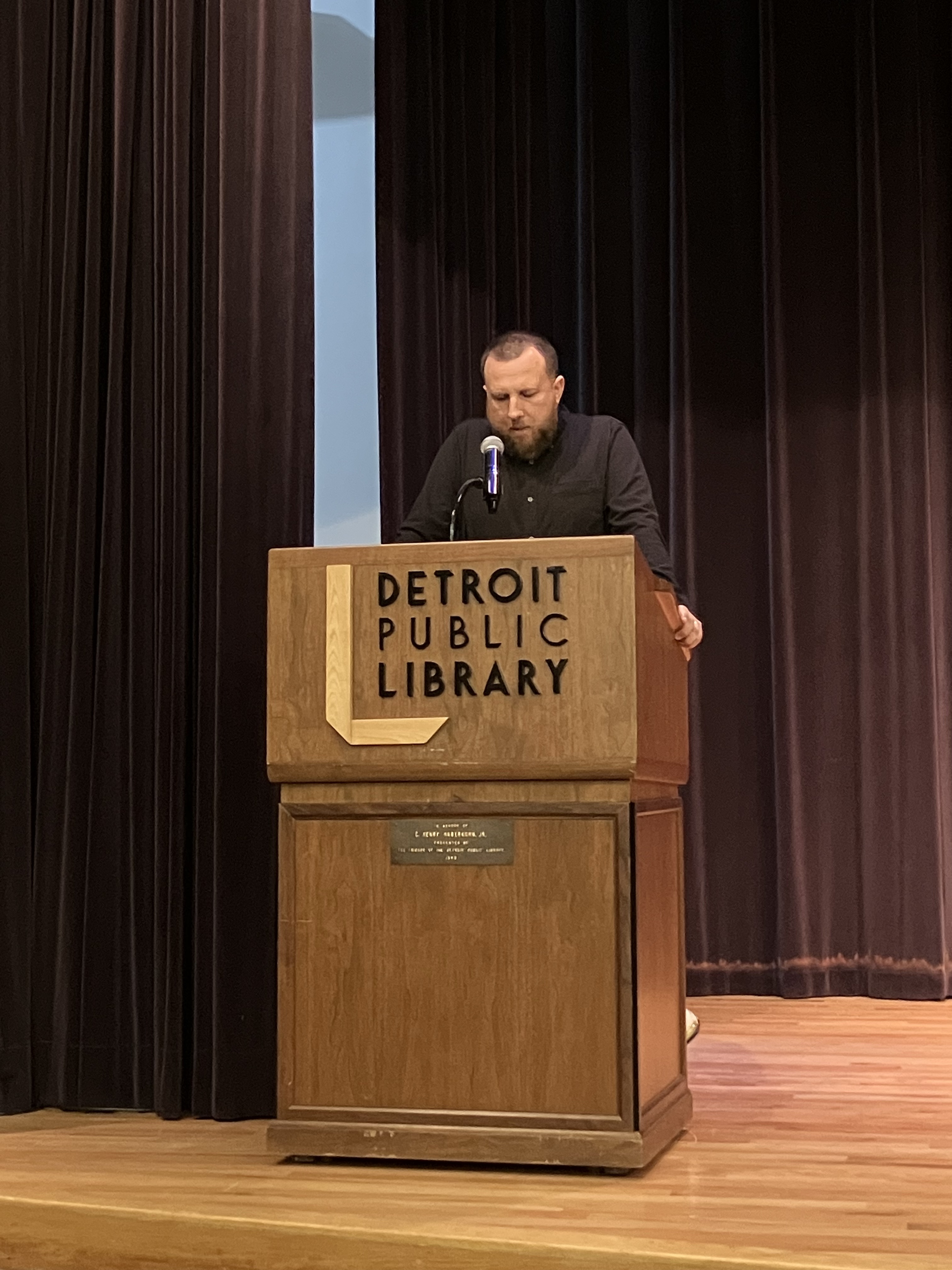
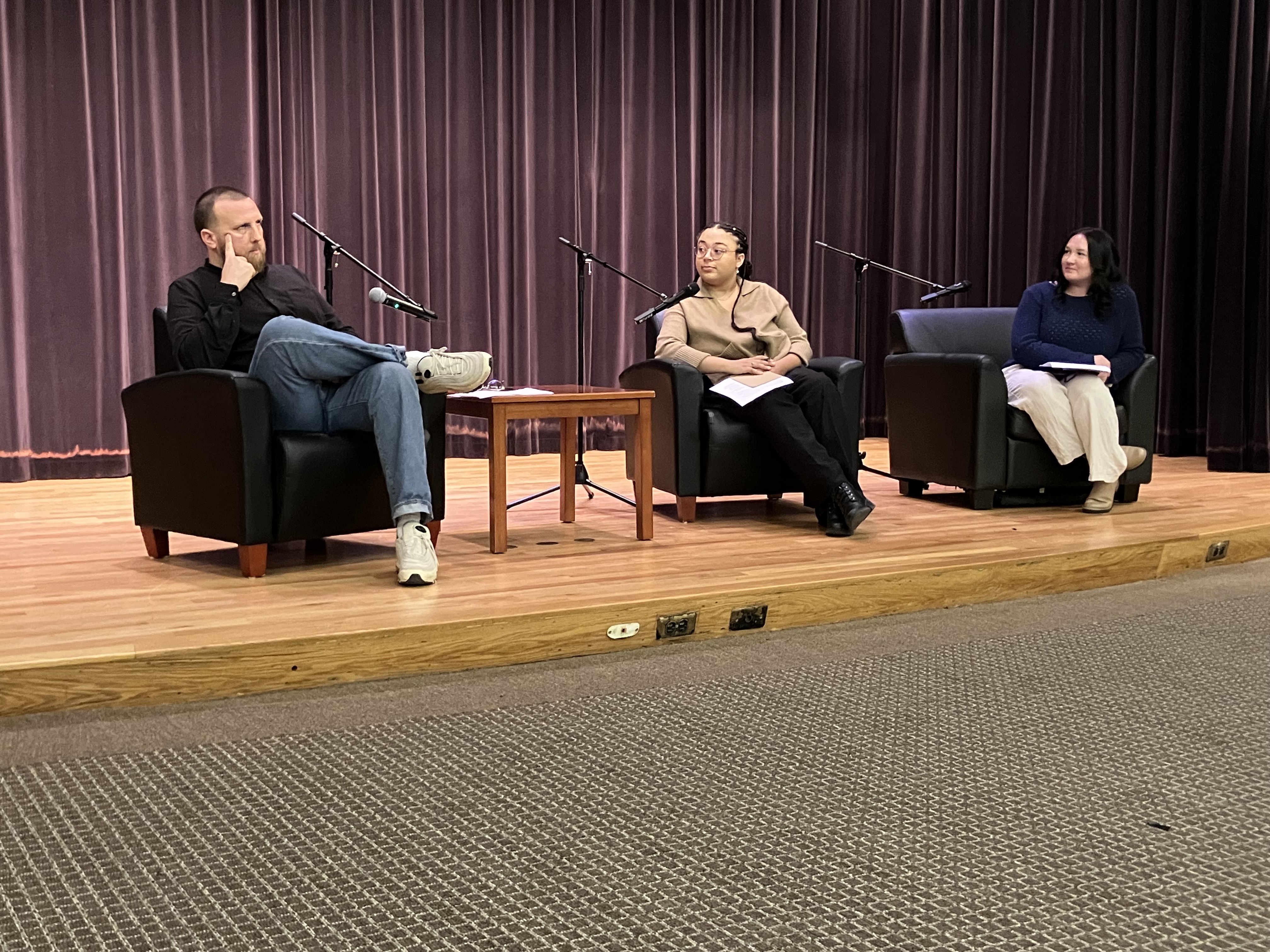
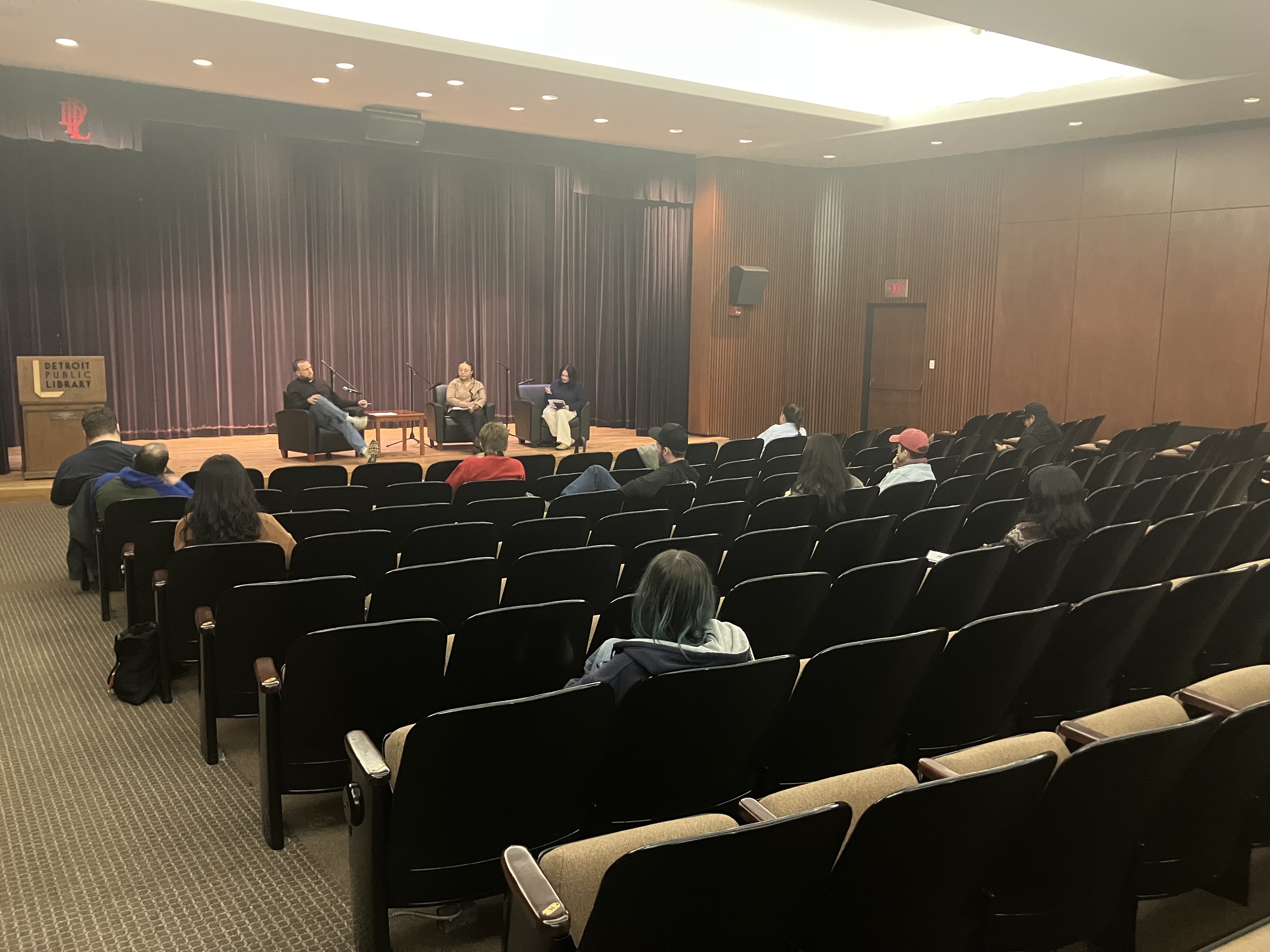
Images from 1968 in 2025: Against the Archive at the Detroit Public Library on October 25, 2025. Photo by Ashley Cook
Walter Lucken IV is Assistant Professor of English at Queens College of the City University of New York, where he studies contemporary political rhetoric in the United States. His previous writing has appeared in Mondoweiss, Michigan Quarterly Review, Lateral, and ROAR.
https://walterluckeniv.substack.com
Michigan Student Power Alliance is a network of radical youth activists building a statewide movement to reclaim higher education and our futures. Since our inception in 2014, we have continued to be the only statewide organization led by youth (including both staff and Board) dedicated to providing comprehensive training, mentorship, and paid, relational-organizing opportunities for students on college and university campuses and in broader communities across Michigan. By equipping youth with the tools they need to create movements rooted in solidarity, liberation, and strategy, MSPA is creating a ripple effect of youth leadership and change in the Midwest.
https://www.mistudentpower.org/
Thank you to the Detroit Public Library, Cully Sommers and Torin Clay for their help in making this event possible.