




An interview with Isabelle Weiss
March 4, 2026

Installation by Paula Schubatis for Art in Action at I.M. Weiss Gallery, 2026
Isabelle Weiss is the founder and director of the I.M. Weiss Gallery, a Detroit-based exhibition space dedicated to representing artists whose work stands at the forefront of contemporary craft and design. Her education in the History of Art and Linguistics from the University of Michigan paired with an appraisal accreditation from International Society of Appraisers has equipped her as a crucial figure within Detroit’s creative community. In addition to her work as a gallerist, she began an appraisal advisory firm called CollectorAnonymous, served on the advisory board and the collections & exhibitions committee at the Marshall M. Fredericks Sculpture Museum, was previously the Chair of the Fine Art Committee of the International Society of Appraisers. She has been invited by design publications including Surface Magazine and Dwell to share her insight, and we are excited to dive deeper into her experiences as a Detroit-based art professional in the following interview:
A: So Isabelle, you’re in your 12th year as the owner of I.M. Weiss Gallery (previously called NEXT:SPACE). After all of these years of success as an art historian, appraiser, curator and gallerist, what keeps you in Detroit?
I: I stay here because I want to make an impact. Looking back over the past 15 years or so of my career in the city, it was not easy, but Detroit is a place that if you work hard enough and smart enough, you can really build almost anything you want. Detroit has its own unique markets with their own unique challenges, but overall, I feel very fortunate to have not just built a career in the arts but a thriving business.
After all these years, I finally feel stable enough to make new investments in the community. I recently decided to introduce a new series of events called Art in Action into the programming at I.M. Weiss Gallery. The first event of the series will be launching this weekend on March 7th-8th, where we will be presenting an installation by Detroit-based artist Paula Schubatis. This work of art is designed to bring awareness to “period poverty”, which is a term used to describe the widespread inability to access or afford safe, hygienic menstrual products, and the lack of education surrounding this topic. For this project, we are also partnering with the local non-profit I Support The Girls to gather menstrual product donations that will then be distributed to Detroit Public Schools and local women’s shelters.
A: How did you come up with the idea for that program?
I: With the state of this world as it is, I have been asking myself, “as just one person, what can I do?” I see my position as the owner and director of I.M.Weiss Gallery as a privilege. I have this platform which enables me to offer advocacy, and I want to be direct with my efforts to provide support to the local community in different ways. With Art in Action, I will create opportunities for people to easily participate in collective advocacy.
A: And in addition to Art in Action, I.M. Weiss Gallery will still have exhibitions?
I: Yes! Ever since moving the gallery to my home in Little Village two years ago I have really been pushing myself to think more and more outside the box (or the white cube as they say). In the past couple of years, we have sort of simultaneously narrowed and broadened our program. We now have a seasonal program that organizes large scale exhibitions, artist talks, book releases, and smaller presentations in the spring and the fall season. Introducing a more dynamic way of programming that includes various approaches to community engagement is very fulfilling to me as a gallerist and has proven to sustain interest from the community too.

Installation by Paula Schubatis for Art in Action at I.M. Weiss Gallery, 2026
A: Can you go a little bit into how you ended up representing artists with craft and design disciplines specifically?
I: Early in my career, I was unable to find anyone working in the Metro-Detroit area that was exclusively focused on local contemporary design and craft, which prompted me to dedicate my work to exploring that world. And as a curator and gallerist, it is important to me to not just show work, but to build an archive of that work.
Over the years, I’ve started to consider myself a “future historian”, where I am very consciously documenting and preserving work that the artists and designers are making now. That is a big reason why we introduced writing and publishing into the gallery programming.
A: Can you talk about some of the artists that you represent through I.M. Weiss?
I: We currently represent about 12 different designers, but we have worked with dozens more over the years. Last summer, we published a book that spotlights the creative process of Lauren Kalman, who we have been working with for the past few years. Lauren hand-throws black clay vessels with very classical forms and then distorts them by pressing into them with her body.
A: Oh, yes. I’ve seen this artist’s work before.
I: We showed some pieces from the initial body of work in 2024 at Stanton Yards. Speaking to this idea of building history, we would for example exhibit work, and then re-exhibit the same work later along with printed images of the initial show, or produce writing about the first show. In this case. We re-exhibited Lauren’s work along with printed photographs of the initial show at Stanton Yards, which were then reproduced in book form. Excitingly, we will be presenting her next iteration of the series later this month (opening March 27th) as part of the National Council of Education for the Ceramic Arts Conference in Detroit.
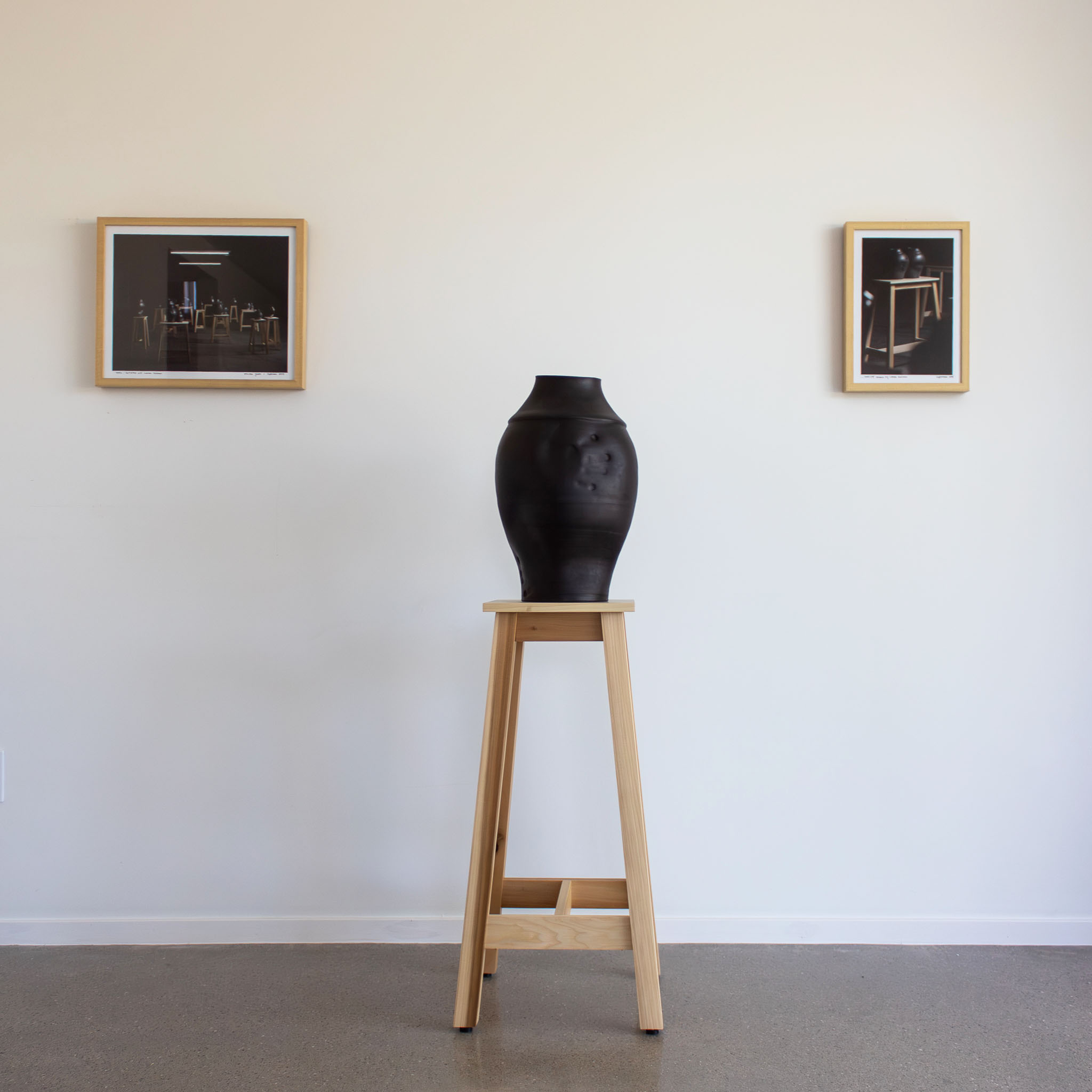
Lauren Kalman at I.M. Weiss Gallery, 2025
A: I am curious about the appraisal aspect of your work. I feel like there are not many people who are informed of the actual valuation of art. When determining the value of an art object, do you have a system that you follow?
I: Art appraisal is an interesting thing. It’s not as much a science as it is an art or an understanding context. One of my degrees is in art history, so I really came into this through the practice of research. It’s important to have a good sense of an object’s quality, asking “is this a good, better or best version of this artist’s work?” “Does this artist have a market or not?”
Throughout my career as an appraiser and gallerist, I’ve had this unique experience of working in both the secondary market and the primary market, seeing things from the collector’s side to the artist’s side. One thing that I stress to the artists that I work with is that it takes time to build value. We’re so used to things cycling so fast in the art world today as it follows the pace of technology and media. What’s important to remember is that stable markets build slowly over time. With long-term dedication from the artists and myself as the gallerist, together, we slowly start to cultivate a market for the artist. It’s like literally one collector at a time, but with that method, you have a sustainable collector-base that has so much more longevity.
A: What is your favorite part about this work?
I: I love it all, but what I love the most is piecing it all together. I love building plans for how all this functions. The art world is a complex synchronization of all these different people, these different things that are happening, and these different entry points. The sales, the market, the monetary aspect, the writing and critical analysis, all of it. I am always challenged with coming up with a solution for how we fit this stuff together in a way that really elevates what each individual artist is doing.
A: What role do you think art criticism has in the valuation of art and design?
I: I think that without art criticism, value can be difficult to achieve. You’ve got to convince people to care about it by properly communicating why someone should care about it, and why it matters in a broader context. For instance, the publication projects that I’ve done have been the most successful sales tools that I’ve ever built, because they are actively creating a context for the work for people to go back to and reference.
A: Have you seen any changes in the Detroit art and design scene over the years since you started your career?
I: Well, the Detroit art scene is a very different place in a lot of ways than it was eight years ago and, in some ways, it is the same. There are hurdles that still need to be overcome, but I do feel like we have become a lot more collaborative as an arts community in the most recent decade, with a newfound focus on social connections and even economic stability within the community.

Portrait of Isabelle Weiss, 2026
Art in Action at I.M. Weiss Gallery:
March 7th 3-6pm: Talk w ith Paula Schubatis and ISTG - Detroit, Director Bekah Page-Gourley)
+
March 8th 12-5pm: Open House. Please note: donation of period products (pads and tampons) are required for entry both days.
I.M. Weiss Gallery
1501 Parkview St., Detroit, MI 48214
https://imweiss.gallery/