




A Few Notes on Sincerity, Which Currently Feels Like a Scam
Alison Campbell
February 18, 2026
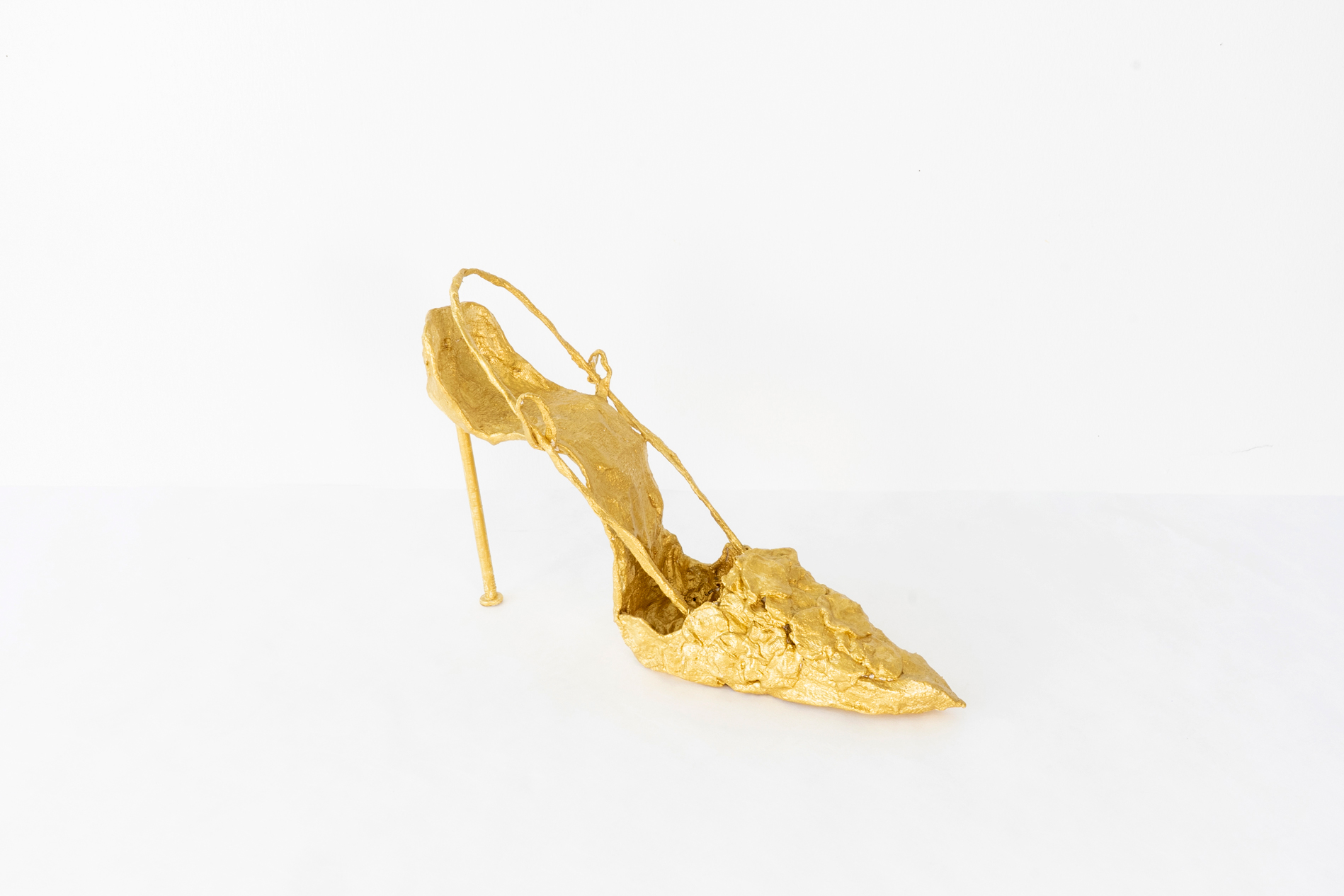
Valentino Garavani, 2022, wire mesh, plater gauze, steel spoke, string, paint, 11 x 6 x 17 inches.
Courtesy of David Klein Gallery. Photo: Samantha Bankle. Image credit: Mary-Ann Monforton
I should probably start by admitting that my first response to being asked whether or not I like something is almost always a mild form of rejection. Not disagreement exactly, but more of a reflexive distancing maneuver, a small shove away from whatever earnestness has just been placed between me and the thing itself.1 I distrust enthusiasm on sight. I distrust my own even more. If enjoyment shows up too quickly or too unguarded, I assume there has been a misunderstanding somewhere upstream.
This has become less a personality trait than a survival tactic. We live, after all, in a moment where pleasure is never just pleasure. It is a signal, a posturing, a brand alignment, a future screenshot. Being immediately agreeable feels like falling for a trick whose mechanism you were supposed to have foreseen. I entered Mary Ann Monforton’s Heart Land at Mike Kelley’s Mobile Homestead ready for a familiar disappointment, ready to again consume a handmade irony, a camera-ready critique and the faint smell of an Instagram square hovering just offstage.
At the entrance to Heart Land there is a photo backdrop hand painted with gold stars and VIP insignias, fake Oscars that look slightly lumpy, as if they’re still rendering, and a comically oversized gold medal with backup copies waiting in case the originals start to crumble from overuse. It looks, at first glance, like a concession to the selfie economy: participatory, ironic, already halfway to being misunderstood on purpose. The kind of thing that, in other contexts, feels like bait. But then the work refuses to do the next step. It does not escalate. It does not reward the performance. The objects stay strange, a little dumb, stubbornly unoptimized.
Inside Mike Kelley’s Mobile Homestead (itself a haunted replica; a house reenacting the idea of a house), luxury objects appear in reduced, awkward form: a hot pink paper-mâché Hermès Birkin, its surface visibly worked, dented, patient. Gold-leaf-coated cement plates, forks, and spoons arranged both ceremonially and uselessly. A deer trophy rendered soft, almost embarrassed by its own existence…These are not critiques that gleam with revelation. They sag. They linger. They look tired in the way real symbols do once they have been lived with too long.
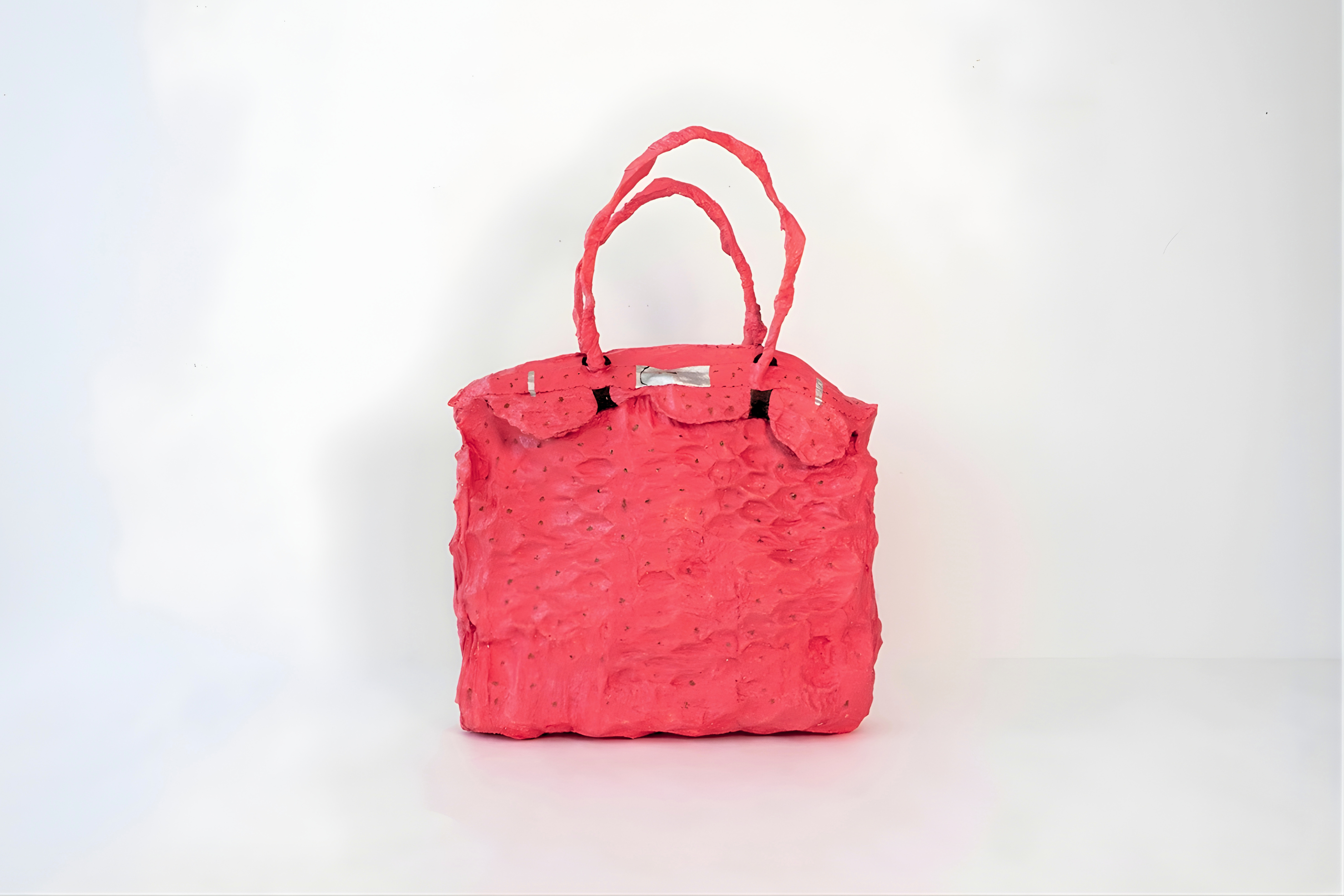
Birkin, 2022, wire mesh, plaster gauze, paint, 21.5 x 18 x 7 inches. Courtesy of David Klein Gallery. Photo: Samantha Bankle. Image credit: Mary-Ann Monforton
The Birkin, especially, does not perform parody so much as latency. It does not sneer at wealth, but it does not celebrate it either. It feels like an object that has passed through desire and has come out slower, heavier, no longer interested in convincing anyone of anything. If this is simulacra, it is not the slick, hyperreal version Baudrillard warned us about. It is the afterlife version, where the copy outlives the novelty and just keeps sitting there, taking up space.2
What is striking is how little the work flatters the viewer. There is no “gotcha” moment. No dopamine hit for recognizing a reference correctly. The moon landing scene with aliens does not read as satire or critique, but as just another room you might wander into without knowing why you are there.
This is where my suspicion started to slip. Because the work does something deeply unfashionable: it appears to enjoy itself. Not loudly or performatively, but quietly, almost in private.3 It is playful without asking permission. It is funny without nudging you to notice how funny it is. Which, in the current cultural climate, usually reads as either naiveté or a kind of conspiracy.
By now, we have learned that sincerity is either a lie or a tactic. That if something looks earnest, it must be hiding something: bad politics, bad faith, bad taste. Or worse, nothing at all. And so we armor ourselves with irony, with theory, with distance, and become connoisseurs of skepticism. What Heart Land risks, and what makes it feel oddly modern, is refusing that armor. The materials show their labor. The seams are visible. The humor is quiet and unsentimental, but not cynical. The objects do not resolve into metaphors that behave themselves. They simply exist, flawed and patient, in a space that already knows too much about replicas and longing.
Moving through the Mobile Homestead, I kept waiting for the moment where the work would reveal its position. It never did. Which left me with the uncomfortable task of sitting there without knowing how to consume it properly. No clear takeaway. No clean critique to repost. This is, I think, why the show feels intact. Monforton is uninterested in becoming a prop for anyone’s better self. And maybe that is what sincerity looks like now: not a return to belief, nor a refusal of irony, but a stubborn indifference to being optimized. A willingness to appear a little uncool, a little exposed, a little beside the point.
After all of this suspicion, all of this defensive architecture, it feels almost irresponsible to say that I enjoyed the show. Not in a redemptive way. Not as a counterexample to some looming cultural thesis. Just in the simplest sense: I liked being there. I liked moving through it. I liked the way the objects let me see where they stopped.
That might be the real distinction. In a moment when it is increasingly difficult to tell what is AI-generated, optimized, filtered, or engineered to meet you halfway, when even handmade things can feel suspiciously frictionless, these works keep their edges. You can see where the material resists the idea. Nothing here pretends to be smarter than it is. Nothing pretends not to want you. The gold-leaf cement plates do not offer a thesis on wealth so much as the dull aftertaste of it. The deer trophy hangs there without menace, emptied of conquest, its authority softened into something almost shy. Even the moon landing with aliens feels less like commentary than a quiet admission that the future arrived and no one quite knew what to do with it once it did.
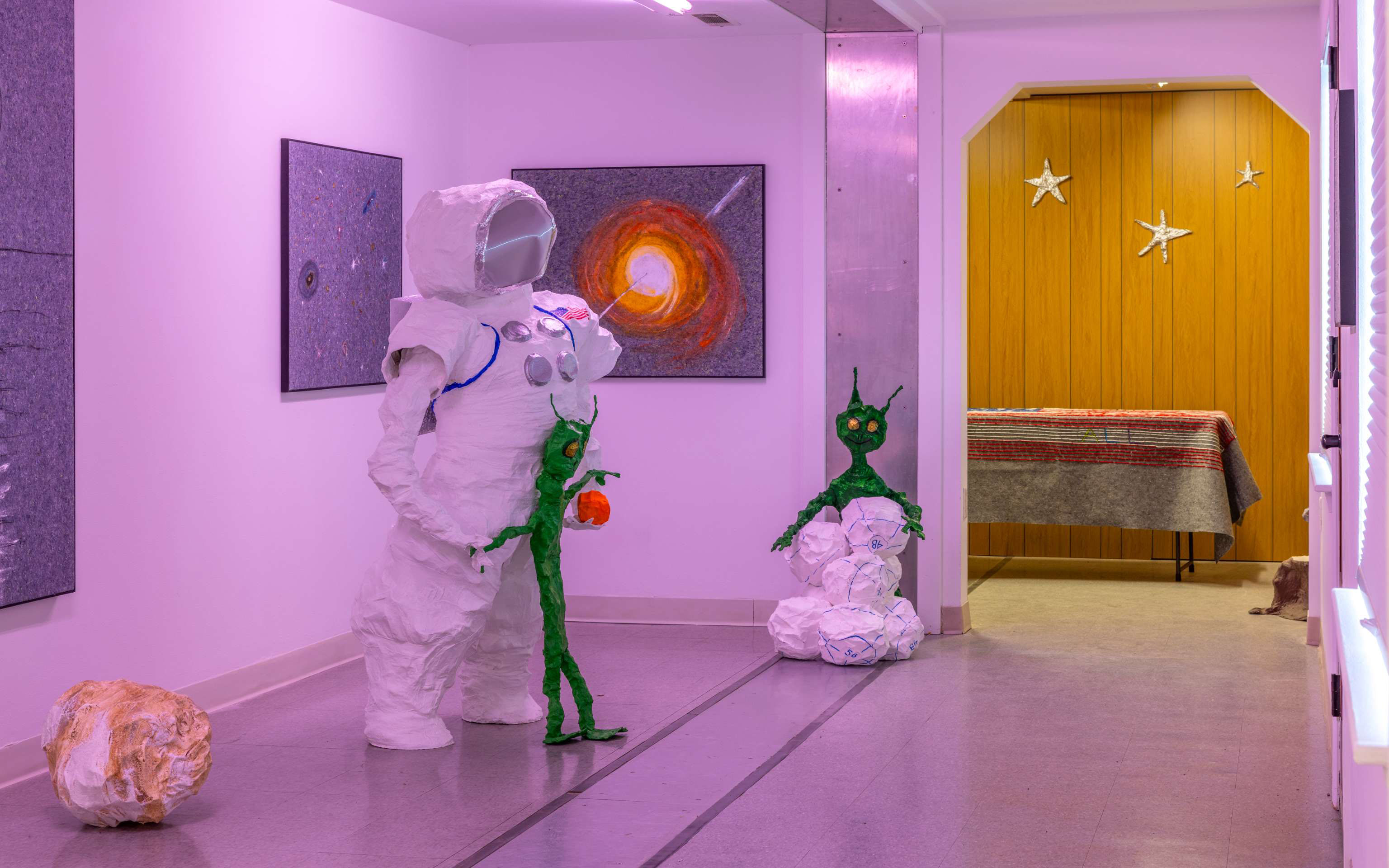
We are Family, wire mesh, plaster, plaster gauze, cardboard, plastic, rope, glitter, paint, 2025. Photo: Museum of Contemporary Art Detroit
This matters more than it should. We are surrounded by objects that demand literacy before they allow pleasure: objects that require you to know how to read them correctly, how to position yourself in relation to them, how to demonstrate that you are not fooled. Heart Land does not test you that way. It does not reward suspicion. It does not punish ease. It lets you notice the difference between something that wants to be seen and something that wants to be used.
https://mocadetroit.org/mary-ann-monforton-heart-land/
1 This predictive behaviour is closer to self-defense than humility. It is a way of controlling the terms of engagement before someone else does it for you. This reflexive distrust is not strictly personal, which is part of the problem. It has become professionalized. Most of us are highly trained in the early detection of traps and are fluent in the language of trickery, risk and exposure. Armed with hypervigilance, we know how things are supposed to fail, which means that when something appears to enjoy itself, we look for signs of manipulation or incompetence, or perhaps the more embarrassing possibility in which there is nothing behind the gesture at all. No critique or scaffolding to hide a motive: just the thing, sitting there, apparently fine without us.
2 If hyperreality once described a world in which copies replaced originals, we may now be living in a phase in which even the copies are bored with themselves. The simulacrum no longer seduces; it persists. It remains not as spectacle but as furniture, an ambient condition one learns to live around rather than interrogate.
3 I keep thinking about Jonathan Richman’s “A Plea for Tenderness,” which I do not mean as an argument.
Addendum to Note 1
1a. There is also the quieter, more humiliating dimension of this distrust, which is that it is frequently mistaken for discernment. We are rewarded socially, intellectually, algorithmically for our inability to enjoy things plainly. Suspicion reads as rigor. Detachment reads as intelligence. The refusal to be moved becomes a credential. Over time, this trains a particular kind of affective paralysis: you can still recognize when something is clever or well made or even generous, but you experience that recognition as an administrative task rather than a sensation. Appreciation becomes bureaucratic. Pleasure is delayed pending review.
This is especially pronounced in spaces saturated with cultural capital, where enjoyment feels like an ethical liability. To like something too easily is to risk alignment with the wrong future screenshot. So you hedge. You qualify. You wait for consensus. You learn to enjoy things retroactively, once they have been approved, historicized, neutralized. Which produces the odd contemporary phenomenon of people who are exquisitely articulate about why nothing quite reaches them anymore, and who confuse this numbness for sophistication rather than, say, exhaustion.
1b. Of course, it is also possible, annoyingly, embarrassingly possible, that this entire diagnosis functions as insurance. A way of protecting oneself from the simpler problem, which is that enjoyment requires exposure: attention, vulnerability, time spent without the guarantee of return. It may be that the refusal to enjoy things plainly is less a critique of the culture than a preemptive strike against disappointment, against the risk of caring and discovering that the care was unnecessary or unreciprocated. This interpretation is deeply inconvenient and therefore should be treated with caution. I am, of course, better at diagnosing it than resisting it.