




An Interview with Gabrielle Banzhaf and Jon Gott of SHED Projects, Cleveland
July 27, 2026
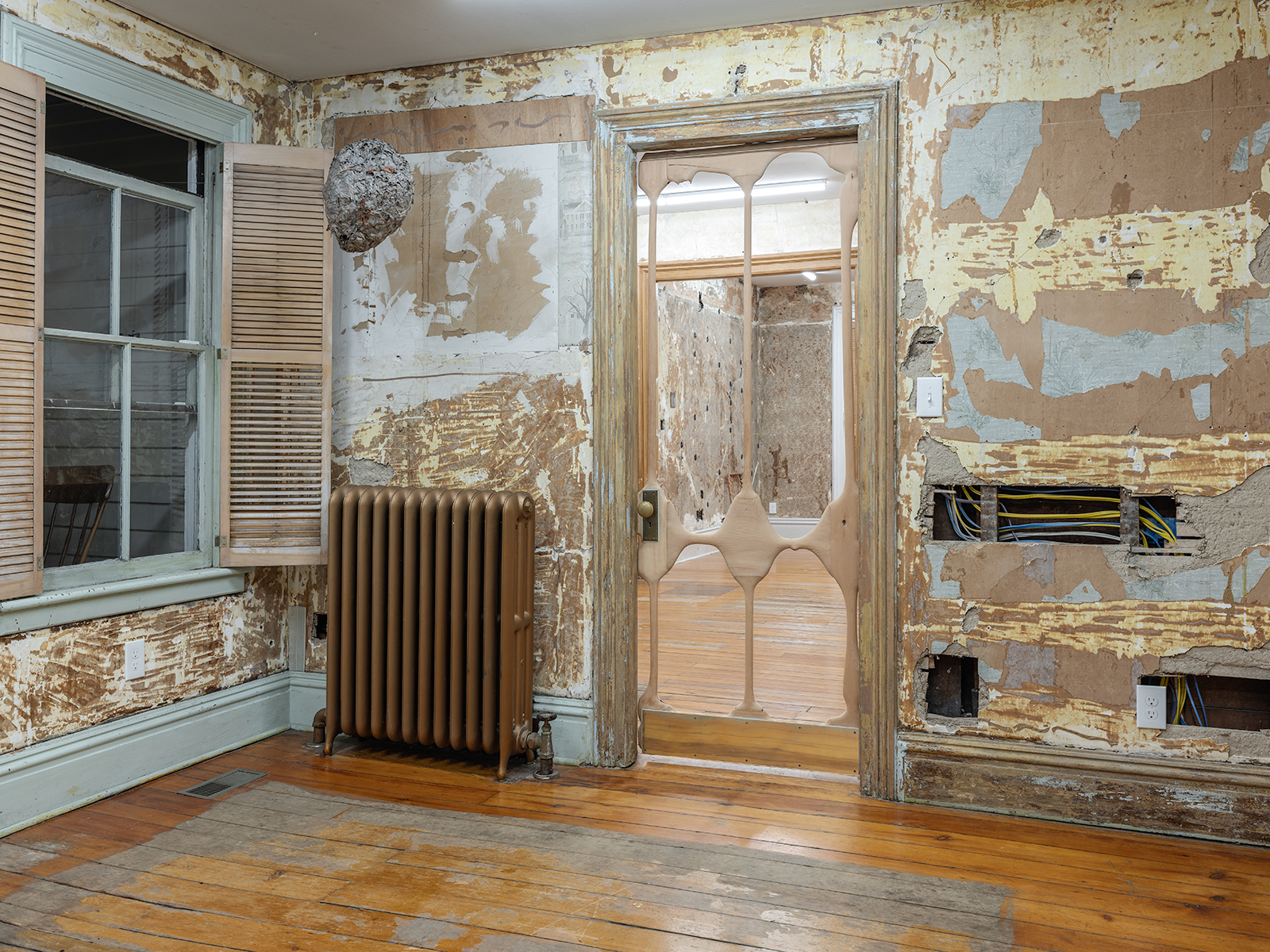
Outdoor installation detail of Pocket, a solo exhibition by Travis Morehead presented by SHED Projects, Cleveland, Ohio, 2025. Spanning the entire property, the immersive installation employed harp strings and wasp nests to create a resonant network connecting the exterior grounds and interior architecture of SHED’s 1857 landmark home. Activated during the exhibition opening with a bow, the work transformed the historic structure into a playable instrument.
Gabrielle Banzhaf and Jon Gott founded SHED Projects in 2021 in the backyard of their home in the Bywater neighborhood of New Orleans, Louisiana. Over the course of one year, they hosted artist residencies, workshops, artist talks, and exhibitions that blurred the boundaries between family life and social practice. Their relocation to Cleveland in 2023 was prompted by their drive to establish a long-term art space dedicated to experimentation and knowledge-building around visual culture. Today, SHED operates in the residential space of Banzhaf and Gott. Built in 1857, their home is a dedicated historic landmark that was previously the location of a father and son podiatrist practice for more than 50 years. Now, 3731 Pearl Road inspires a sense of wonder, and a curiosity about the potentials of working and exhibiting in a space so rich with temporal footprints.
Cleveland’s Gilded Age moniker, “Forest City”, originated in the 1850s, illustrating the presence of dense canopies of oak, sycamore, and maple trees that arched over the brick streets of exclusive residential districts. These green corridors were the result of extensive tree-planting programs, complementing the natural beauty of the Great Lakes, and contrasting the billowing smokestacks of the city’s industrial valleys.
Like other places in the Rustbelt, Cleveland embodies a complex history of manufacturing that both relied on—and compromised—the integrity of its natural resources. Between 1860 and 1930, the city transformed from a small shipping port into a powerhouse for steel production and oil refining throughout the Second Industrial Revolution. Much of this success can be attributed to Cleveland’s central location along both the shipping routes of the Great Lakes and the Midwestern Railroad network. Its position on Lake Erie also allowed for efficient and inexpensive access to the iron ore of the Sault Ste. Marie Canal, and coal from the Appalachian fields of southern Ohio and Pennsylvania, both of which were crucial to the production of steel at that time. Cleveland quickly became the fifth biggest city in the United States, attracting people from around the world to work in the boatyards, warehouses, iron ore docks, and black furnaces that were densely packed along the Cuyahoga River.
As important as these industries were for the progress of the modern world, their integration within the fabric of Cleveland’s natural landscape resulted in air and water pollution, which the city is still working to amend today. After international competition, corporate restructuring, and aging infrastructure caused the city to lose its competitive edge on the world stage, several initiatives have been implemented to repurpose industrial sites, commercial buildings and residential homes. SHED Projects is an non-profit organization based in the Brooklyn Centre neighborhood that demonstrates adaptive reuse as both a functional and conceptual practice.
Gabrielle and Jon’s radical embrace of heritage shows up in their appreciation for imperfections typically shunned in contemporary art spaces, encouraging artists to collaborate with a space that is more than 150 years old. They have built a permanent collection of works that merge with their surroundings, and host exhibitions and events among them.
SHED Project’s dynamic programming comprises “One Piece Viewings” of a single work on view for a single day, longer-term solo and group exhibitions both on and off-site, and film festivals. As graduates of the Cleveland Institute of Art, Gabrielle and Jon are sympathetic to those affected by the rising costs of education in the US, and have chosen to incorporate free or affordable opportunities for new learning as well. This is realized through their “Reading List” of books, essays, and research materials curated by exhibiting artists, their implementation of SHED School, and the Curriculum Fair, which was curated and organized by Jon Gott and Malena Grigoli. This fair took place in the summer of 2026, hosting guided conversations and workshops over the course of a weekend as resources for self-guided education.
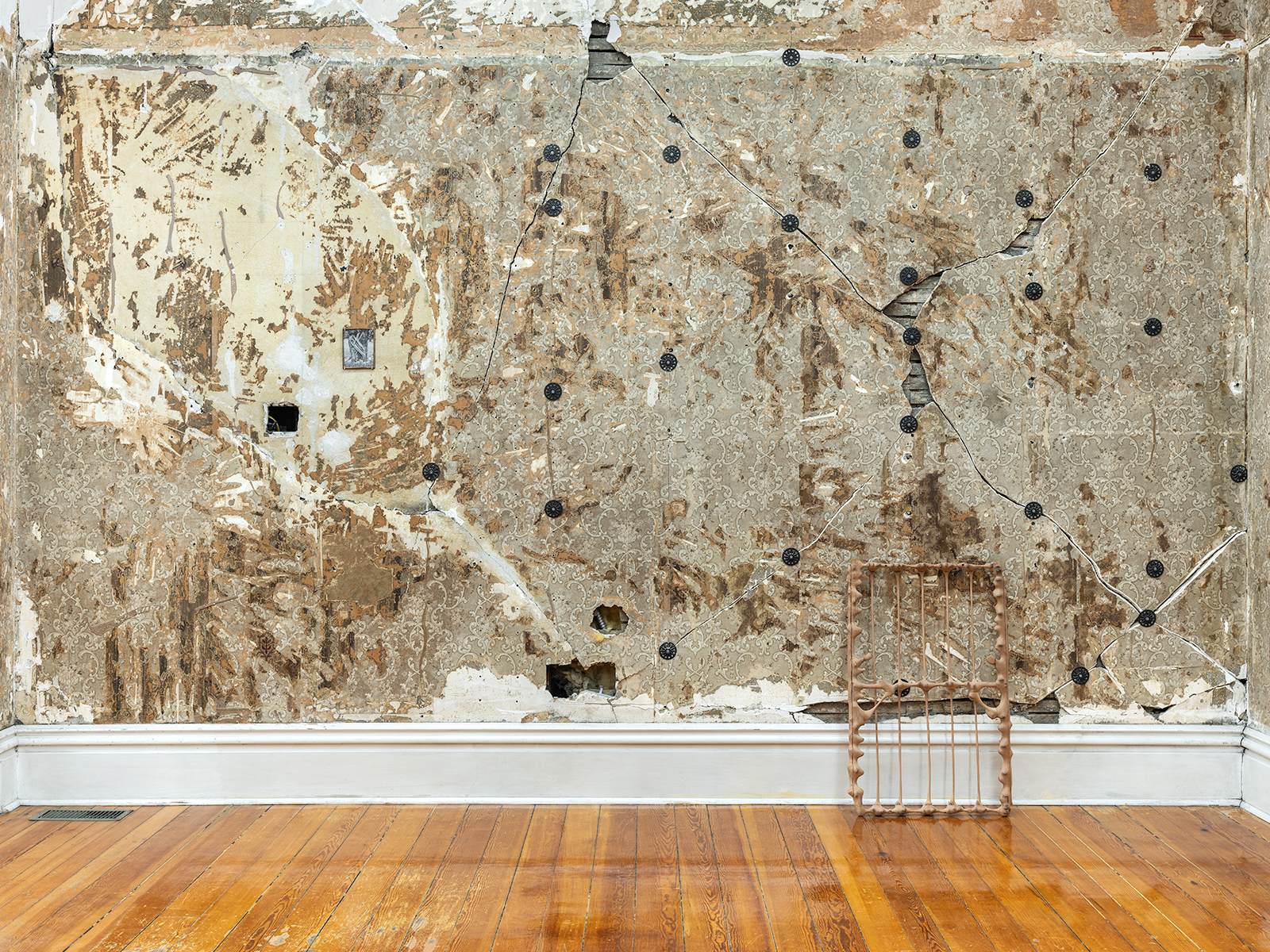
Interior installation detail of the instrument from Pocket, a solo exhibition by Travis Morehead presented by SHED Projects, Cleveland, Ohio, 2025. Photo Credit: Courtesy of the artist and SHED Projects.
Since 2021, SHED has maintained a schedule that consistently centers empathy and connectivity between people. In addition to highlighting the practices of contemporary artists from a wide array of backgrounds, the team has made room for philosophical discourse around human feeling and the lived experience. This is demonstrated through the reflective writing on their website, which links intellectual work with real life manifestations.
Gabrielle and Jon share some insight on their experience starting and maintaining this experimental creative space in Cleveland…
runner: SHED began in New Orleans, and then became rooted in Cleveland a few years ago. From my understanding, both cities have very active scenes of artist-run organizations. How do you feel that these cities have influenced your approach to programming?
SHED: We have family in both cities, and other connections going way back. In both there was good connective tissue and an emotional depth to grab onto. The projects are influenced by that as much as by the art scenes in either. The house on Pearl Road was chosen because of Gabi’s family ties to the neighborhood. On Poland Avenue, because of our location, we had the fortune of attachment to the highly energetic art scene already present in Bywater. Everyone wanted to visit New Orleans, so we were able to bring artists from all over the world. We’re finding the same is true for Cleveland. We continue to work between the two cities, and a lot of what we do with SHED has to do with what’s carried between them.
We find language around “artist-run” is inadequate- overly vague, undefined. There are artist-run organizations where artists bring their creative powers and visions to work each day. Then there are organizations that employ artists to fill administrative roles. There are commercial galleries and other capital endeavors owned by artists. These are all very different things.
SHED is majorly, though not entirely, artist-run, but we insist that artists involved on an organizational level be invited to act primarily as artists. We are a family business in contemporary art and ideas that became a nonprofit organization. The organization formed around our core family values, operating from our family home. In many ways, we are neither a typical artist-run organization nor a typical nonprofit arts organization. We’ve found the language around our work to be both problematic and exciting to unpack and sift through. Much new language is needed. It’s why I began, only partly joking, referring to us as SHED Home for Advanced Research in Ancient Modern Living, Interpretive Dance, and Cultural Sorcery. It actually feels closer to what we do.
Planting roots in Cleveland, we expanded our footprint and scaled up our operations extensively. Establishing a stable home base benefited our work in many ways, but we also rely on moving things around, so we continue to travel a lot. Much of what we do relies on direct, personal contact, and we undertake extensive fieldwork to achieve that in both curatorial and organizational development. In October our board and fellows will meet in New Orleans for our second annual exchange trip, building community and taking in that spirit.
Because we began in our home, there’s an intimacy and emotional depth built into our approach. We continue to seek intimacy; that’s a major driving force behind our work. The idea of social intimacy breaks down boundaries and reshapes expectations of what happens between public and private life.
Things in New Orleans that are artist-run, in the truest sense of the term, which have inspired us, are too vast to name, let alone fully identify. The spirit of not celebrating the art-likeness of things is almost nowhere to be found. New Orleans is such an activist space that it’s atmospheric. There’s a depth of sadness and joy, and a raw human spirit with enormous power to influence one to become exposed, encounter discomfort, and entertain bold life propositions.
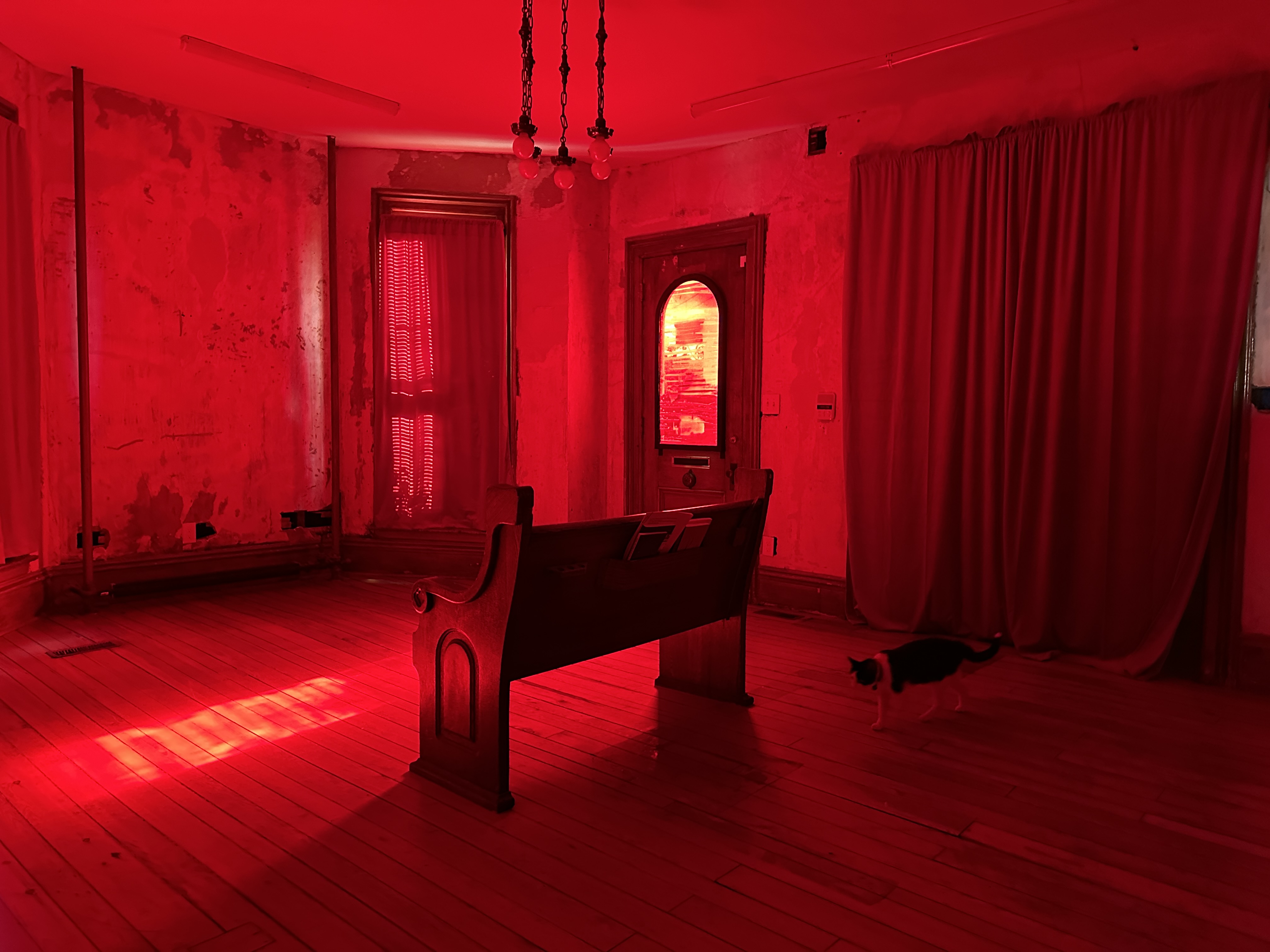
Interior installation view of the main sanctuary from The light shines in the darkness, and the darkness has not overcome it., a solo exhibition by Shabez Jamal presented by SHED Projects, Cleveland, Ohio, 2025. The artist transformed the gallery into a meditative viewing room oriented around the reflected light patterns cast through SHED’s front door. Incorporating archival material, new imagery, and experimental video, the immersive installation explored the metaphysical dimensions of Black space and considered the ways ritual, memory, and spiritual practices emerge in response to histories of displacement and racialized urban planning. Drawing upon the intertwined histories of the Kinloch Cotton Club and First Missionary Baptist Church of Kinloch, the work reflected on the persistence of sacred and communal traditions and the enduring capacity of light, spirit, and collective memory to resist erasure. Photo Credit: Courtesy of SHED Projects.
It’s actually like a cloud or haze that pulls you in, inducing you to become totally engrossed and mesmerized. It’s deeply inspiring. The city has impressively resilient and vital artist communities spread across neighborhoods, some loosely organized together, within walking distance– Bywater and St. Claude, where SHED began. New Orleans has a tremendous amount to offer in that regard, in attitude alone.
Cleveland has a handful of active artist-run organizations. To a greater extent, it has a true underground, fragmented by the nature of its multitude of independent operators who occasionally overlap. It happens in garages, basements, apartments, homes slated for demolition, in parking lots, in waves of varying durations and intensities. Loosely structured collectives or scenes have emerged when mixed use, warehouse, or other post industrial vacancies have become homes for elusive and transient endeavors in art undertaken by artists going back decades. Much of it is completely informal and decentralized, and in many cases totally indifferent to the idea of a scene. Most of our influences are anti-establishmental rather than organizational. Our idols aren’t organizations in a formal sense, but people doing impressive and special things entirely on their own, with or without a social circle willing to put in the work. SHED brings the underground to the surface, or supplies the tools for digging.
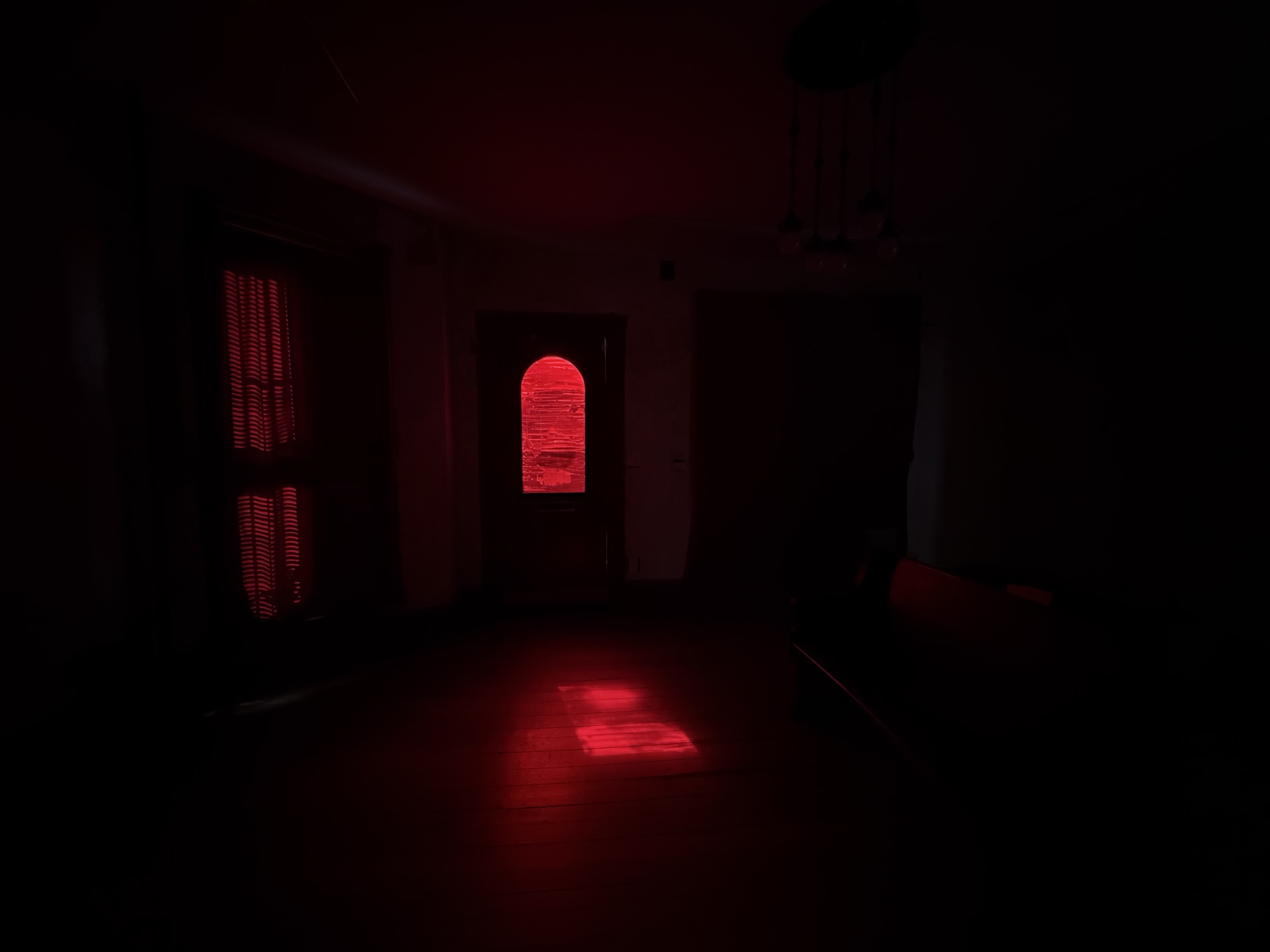
Interior installation view of the main sanctuary from The light shines in the darkness, and the darkness has not overcome it., a solo exhibition by Shabez Jamal presented by SHED Projects, Cleveland, Ohio, 2025. The artist transformed the gallery into a meditative viewing room oriented around the reflected light patterns cast through SHED’s front door. Incorporating archival material, new imagery, and experimental video, the immersive installation explored the metaphysical dimensions of Black space and considered the ways ritual, memory, and spiritual practices emerge in response to histories of displacement and racialized urban planning. Drawing upon the intertwined histories of the Kinloch Cotton Club and First Missionary Baptist Church of Kinloch, the work reflected on the persistence of sacred and communal traditions and the enduring capacity of light, spirit, and collective memory to resist erasure. Photo Credit: Courtesy of SHED Projects.
The draw of Cleveland is that it’s wide open. There are literally thousands of vacant structures ready to inhabit. Last month we hosted a one night only exhibition in the vacant fire station next door. In the fall we’ll present Short Cuts, our experimental short film festival that premiered in the backroom above a bar in Milwaukee in 2023, now taking place at two of our favorite theatres in Cleveland, on both the east and west sides.
Things about Cleveland mentioned in your opening remarks are compelling when considered through the lens of reuse as a conceptual framework. The city’s central role in industrial modernization, and the voids and embedments left behind by that extraction and contamination. We encounter these in public service, in home and cultural work, preservation, intervention, and daily life. When we arrived back here we found the city strange and homelike. Within that familiarity and mystery is a whole unexplored universe of things and a lot of work to be done.
We love the home as a neighborhood cultural center and school. Radicalizing the home may simply mean opening its doors. It would be incredible if SHED wasn’t so special, but normal. What if this model were applied citywide with public resources. What if every neighborhood had a SHED house?
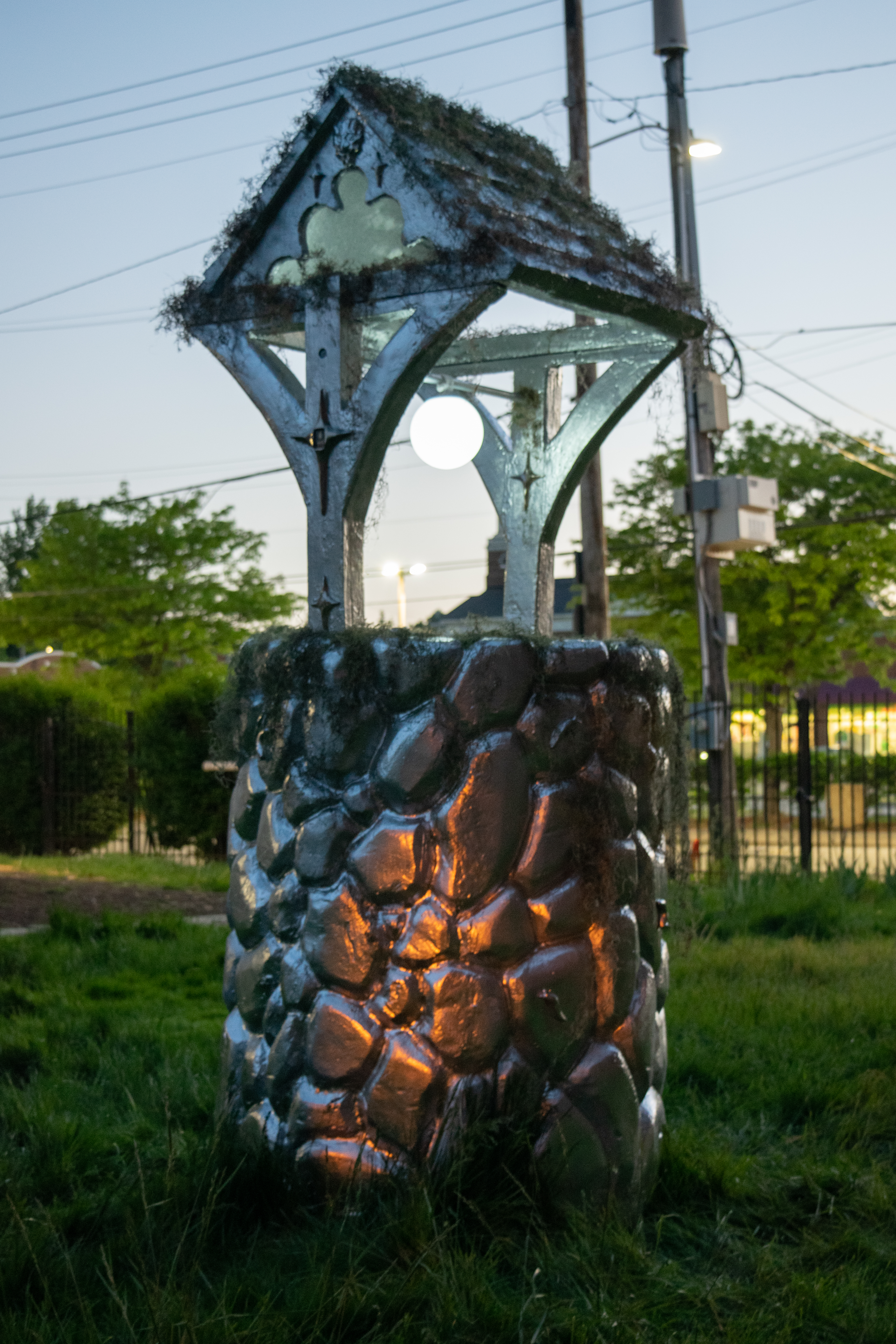
Outdoor installation view of Wishing Well by Margaret Kammerer, presented by SHED Projects, Cleveland, Ohio, 2024. Reimagined from the artist’s MFA thesis installation, originally exhibited within an academic setting, the work realized Kammerer’s vision of presenting the sculpture outdoors. Drawing on the visual language of Y2K futurism and the symbolism of wishing wells, the installation invited participants to engage themes of hope, nostalgia, and our evolving relationship to technology. Photo Credit: Courtesy of SHED Projects.
runner: You are an organization for contemporary art, but your cerebral approach to the projects—and the writing about the projects—stands out against the typical “art for arts sake” strategy. What inspired this? And how do you feel that it has impacted decisions around the trajectory of SHED Project?
SHED: We understand art as inherently social, political, and philosophical. One role it plays is to push society forward, and to push against it when urgency arises. Recent research in archaeology and cognitive science offers compelling evidence that art and symbolic behavior were deeply entangled from the origins of human cognition and social life. Rather than being a cultural luxury, artistic practices appear to have been woven into the daily life processes that shaped modern consciousness, collective life, and the contemporary human nervous system. We recognize the subject of art as the totality of human experience and consciousness. These things can’t be ignored, and it’s exciting to confront them at home.
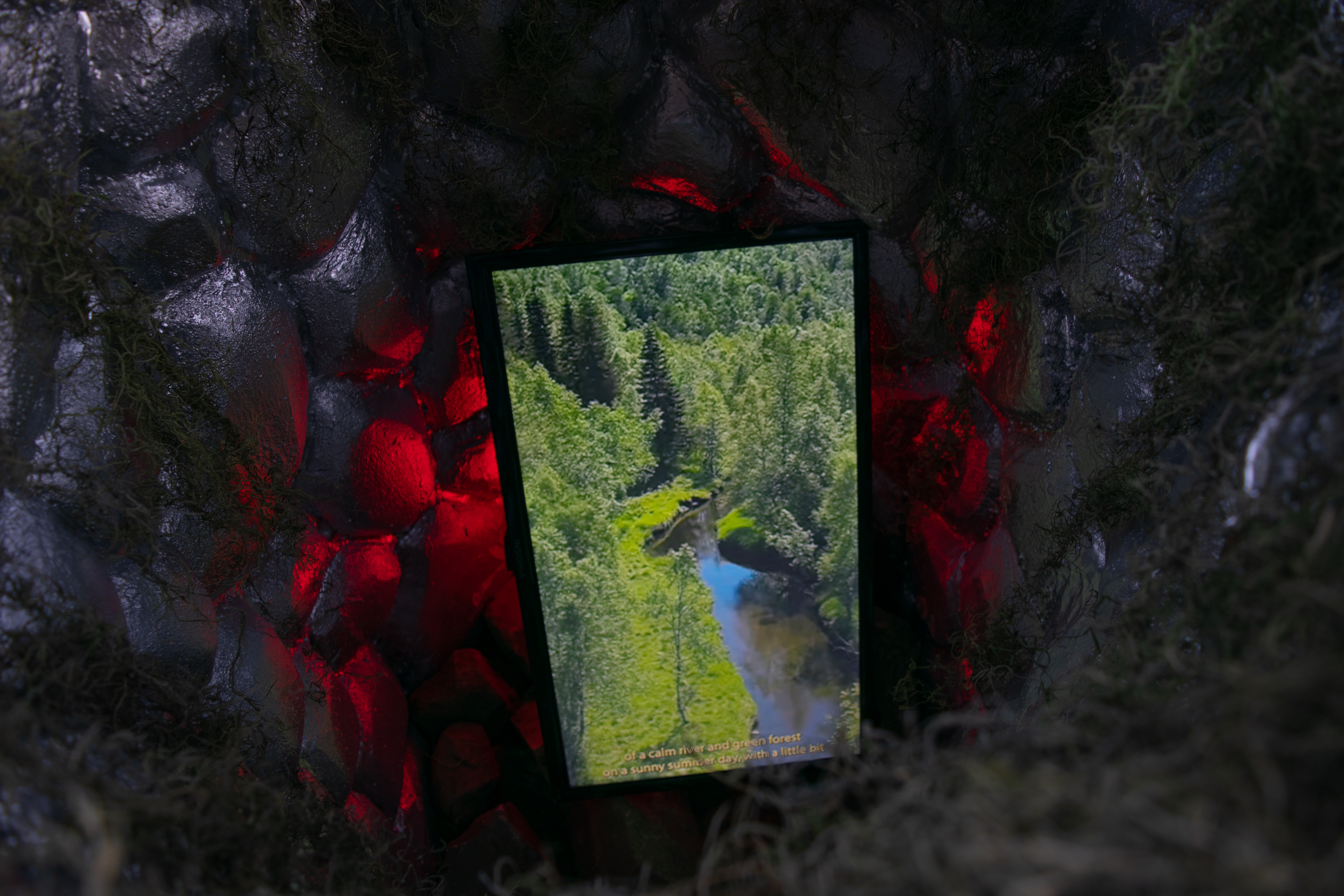
Detail view of the interior of Wishing Well by Margaret Kammerer, presented by SHED Projects, Cleveland, Ohio, 2024. Photo Credit: Courtesy of SHED Projects.
“Art for art’s sake” might seem a low-hanging fruit, but it’s only a limiting and unimaginative position if you let it be that way. It can feel lazy or fearful, as if art isn’t a thing that warrants deep exploration and interpretation, or as if there is a fear of encountering art and ideas at their actual depths. If you aren’t careful, you may end up decorating the city rather than bringing art to it. The people in Cleveland have a high degree of cultural literacy and a sense of urgency about life. It’s insulting to them and to artists to assume they aren’t capable of going deeper and approaching uncertainty. Depending on how such things are defined, our work could be seen as art for arts sake, but the conditions of what art can be are vast, unfixed, and fluid.
Part of what you’re talking about is curatorial work: writing and research involved in building out an idea or a project, and how those are recorded and documented. There’s always a paper trail marked by everyone involved. There is a paper trail leading to the project—the texts the artist has read, the observations that have been made, and the research being undertaken. These form our reading lists, which accompany projects. While a lot of writing is produced and shared in relation to projects, we resist didactics and the imposition of fixed languages. Texts are presented as an option for further inquiry, to present multiple, layered, and relational considerations, rather than to limit the approach.
With limited funding, SHED Projects functions mainly on a volunteer basis.
Their Program Coordinator for SHORT CUTS film festival, Kaliban Zehe, was sponsored by a grant from the Cleveland Foundation.
They also have a graphic design intern, Gianna LeMaster, who works with them for school credit from Cleveland Institute of Art.
Gabrielle Banzhaf
Co-founding Director + Chief Curator
Jon Gott
Co-Founder and Director of Research and Special Projects
Board of Trustees:
Malena Grigoli
Jorge Lucero
Orlando Caraballo Ortiz
Shari Wilkins
SHED Projects is located at
3731 Pearl Road, Cleveland, OH 44109
Learn more at
https://www.shed-projects.org/