




Taliesin Thomas
May 11, 2026
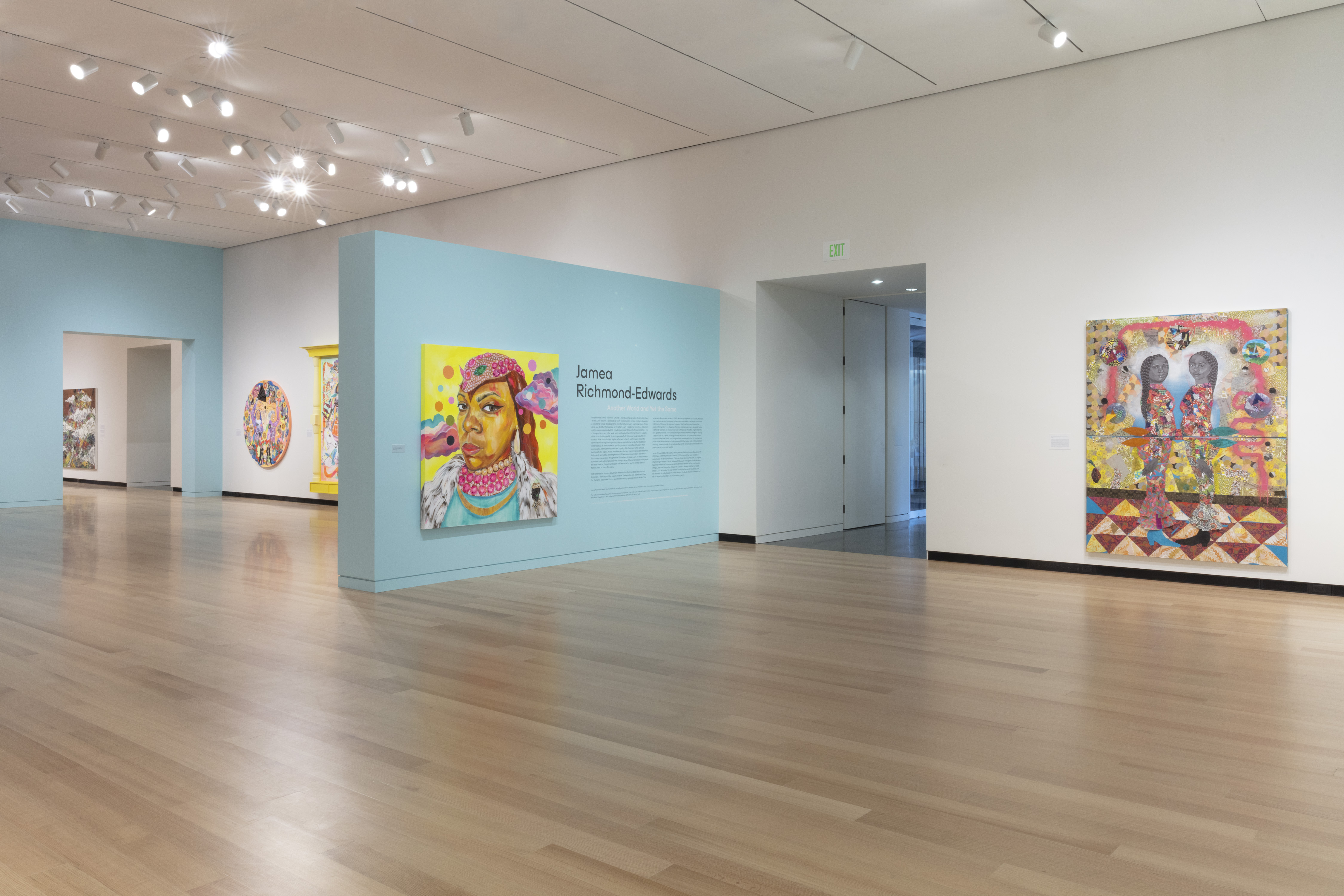
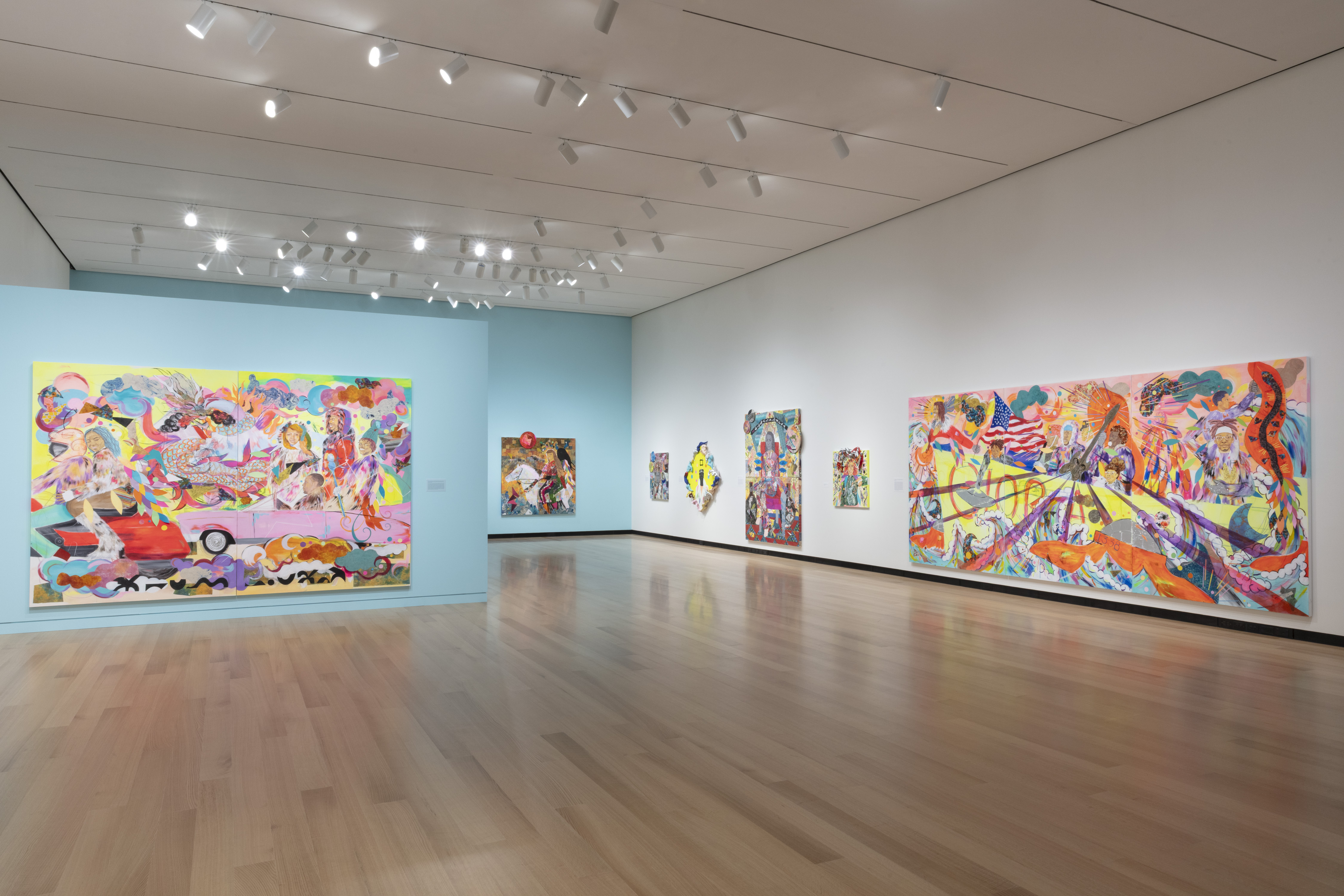
Jamea Richmond-Edwards: Another World and Yet the Same at Ruth and Elmer Wellin Museum of Art, on view from September 13, 2025 — June 14, 2026
“My paintings are prayers,” says Jamea Richmond-Edwards to me on a recent Zoom call, where within a mere hour we cover a wide range of rich intellectual ground. I learn about her passion for all forms of music, her experiences with UFOs, her fondness for period literature, and the ills of drugs in her home city of Detroit—a place she honors deeply and references often. “I came up in the 80s, which was a very harsh time, during the height of the crack and AIDS epidemic. It was literally like a damn bomb went off in our community,” she says candidly about her youth.
Jamea Richmond-Edwards: Another World and Yet the Same at Ruth and Elmer Wellin Museum of Art, on view from September 13, 2025 — June 14, 2026
During that conversation, I feel I am in the presence of an artist-goddess as she describes her spiritual relationship with art, music, dance, and diverse areas of knowledge that have influenced her interdisciplinary practice. “One of the things I find really fascinating is when you look at indigenous cultures around the world, in every corner of the planet, there isn’t necessarily a word for art,” she comments. Edwards reminds me that among certain populations, there is no differentiation between “sacred practices” and “art practices”--and her work is a thriving embodiment of this notion.
Rewind to September 2025 to my road-trip across Upstate New York to visit her solo show Another World and Yet the Same curated by Alexander Jarman at the Wellin Museum of Art at Hamilton College. The title is borrowed from a dystopian literary work of the same name, Mundus alter et idem, c. 1605 by the English satirist and writer Joseph Hall. This imaginary story is about an ocean voyage and the quest for a new land. To witness Edwards’ vibrant cosmos in person was indeed an “out of this world” encounter.
The same occurred for Tracy Adler, the founding director of the Wellin Museum. Years ago during a visit to the EXPO CHICAGO Contemporary Art Fair, Adler discovered Edwards’ 7 Mile Fly Girl (2018) print and was instantly star-struck. This work features a stoic Black woman with a long braid surrounded by a glittery jumble of decorative patterns, and she catches our gaze with her fearless essence. Adler acquired the work for the permanent collection at the Wellin, and the artwork was made available to the Wellin community by way of their online academic resources. Soon enough, the print was being requested by Wellin students in conjunction with their studies and research into art and led to the major acquisition of the mixed-media work Devotional for the Divine Mind (2021), featured in the current exhibition. Adler describes this as an “exciting connection point” that ultimately became the impetus for her current solo exhibition, a collaboration that took three years to realize.
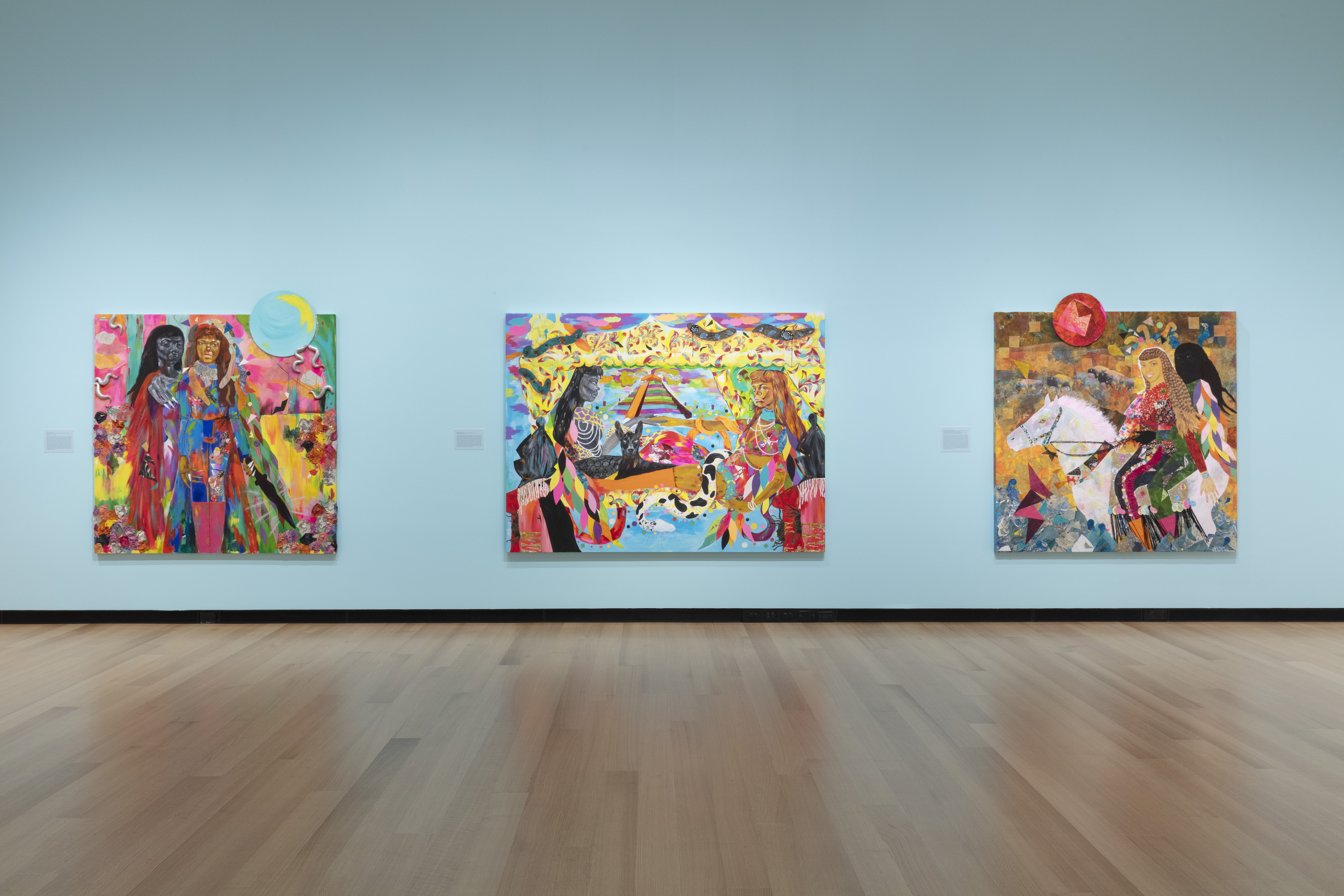
Artworks from left to right: In Search of Mu, 2021. The Great Return, 2022. Devotional for the Divine Mind, 2021.
To engage with her work is to experience magnetism and magnitude. Edwards gives us her imaginative visions through canvases that are round or square with custom frames or ornate columns on the sides. Several of her paintings are self-portraits that vibrate with a majestic heartfelt courage. Edwards explains to me that she only started working in self-portraiture around 2020, citing her early phases with portraiture as self-guided “meditations for an ascension process.”She comments that her self-portraits were created with the viewer in mind, and are meant to give her audience a chance to transpose themselves into the work, to use her as a medium for their own transfiguration.
“Could I see myself as divine?” she says in a whimsical voice, as if to query the heavens during our Zoom call. “Could I see myself as the heroine of my story? It was really challenging,” she furthers. “Look at yourself as me. I am doing this for us!” she proclaims enthusiastically as we discuss the image of her in Devotional for the Divine Mind (2021). In this painting, the two Jamea’s (a recurring theme in her art) ride a white horse together. The scene is decorated with a backdrop of yellowish abstract patchwork in the sky, and below, a group of bison traversing a stretch of wavy aqua-blue waters. The woman in front is fierce, joined by a pitch-black figure in a feathery flowing jacket who holds the reins and steers the journey. With this painting, Edwards celebrates her art practice and her spiritual practice as one.
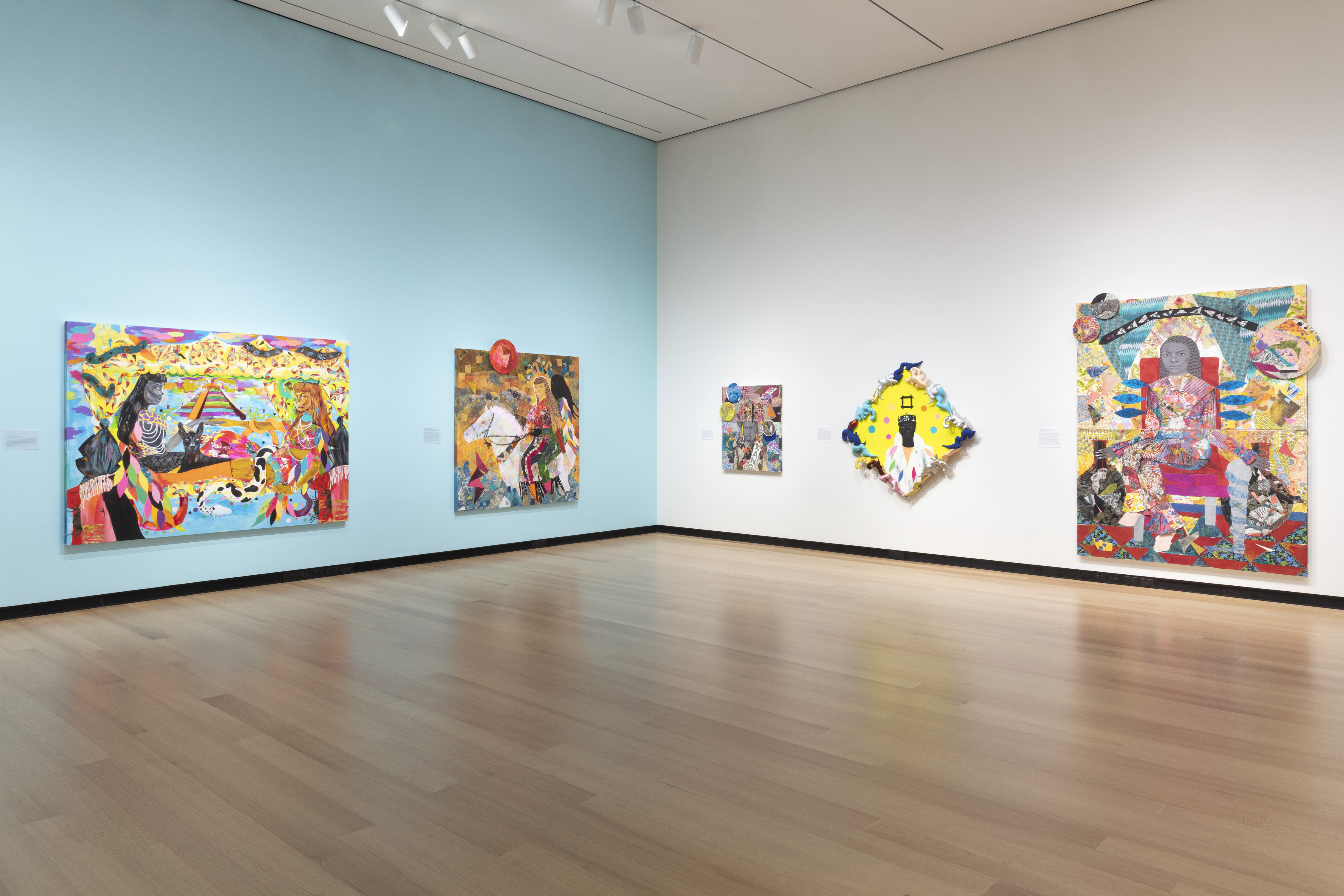
Artworks from left to right: The Great Return, 2022. Devotional for the Divine Mind, 2021. Kang, 2019. The Man, The Myth, The Legend, 2023. Seated Girl on Serpent Throne with Stink Pink Gators, 2019.
She speaks confidently about her identity as a Black indigenous woman, and she has undertaken extensive research to understand her family lineage. Having worked with five expert genealogists over a course of many years, she understands the term “Black” to be a pastiche, and she describes her own skin “color” as Copper, Brown or Indian Red. “Black, Negroe, African American, Colored, Mulatto, Indian. They are all political classifications assigned to my family over generations,” she writes to me in an email correspondence. I am amazed to learn that we share Irish blood as she clarifies that one side of her family has been in America for eight generations, with historical records confirming that her ancestors were Irish Highlanders who immigrated to South Carolina in the 1600’s. She notes that “one of the biggest fallacies of American history is that all dark-skinned people were slaves, overlooking the ‘free people of color’ demographic that always existed.” As we continue our conversation about self-portraiture, a larger dialogue unfolds regarding identity and freedom. “You have all of these constructs that exist, which is fair,” she notes with respect to the complexities surrounding race in the United States. “But within the art space, I am able to be my freest.”
The multi-colored characters in her paintings shine in free-spirited scenes that explode with exuberant energy. Follow Me (2025) is a lively ode to her kin. Her mother “Miss Penny” and her sister are featured looking noble, with dancerly postures and a beaming black orb between them. Both women radiate joy in their purple attire as they raise cloth fans above their heads while smaller flower-head female figures adorn the edges. At the bottom of this family portrait are two smaller versions of Edwards wearing flowing black ruffled jackets, a lion to the left and a rabbit to the right.
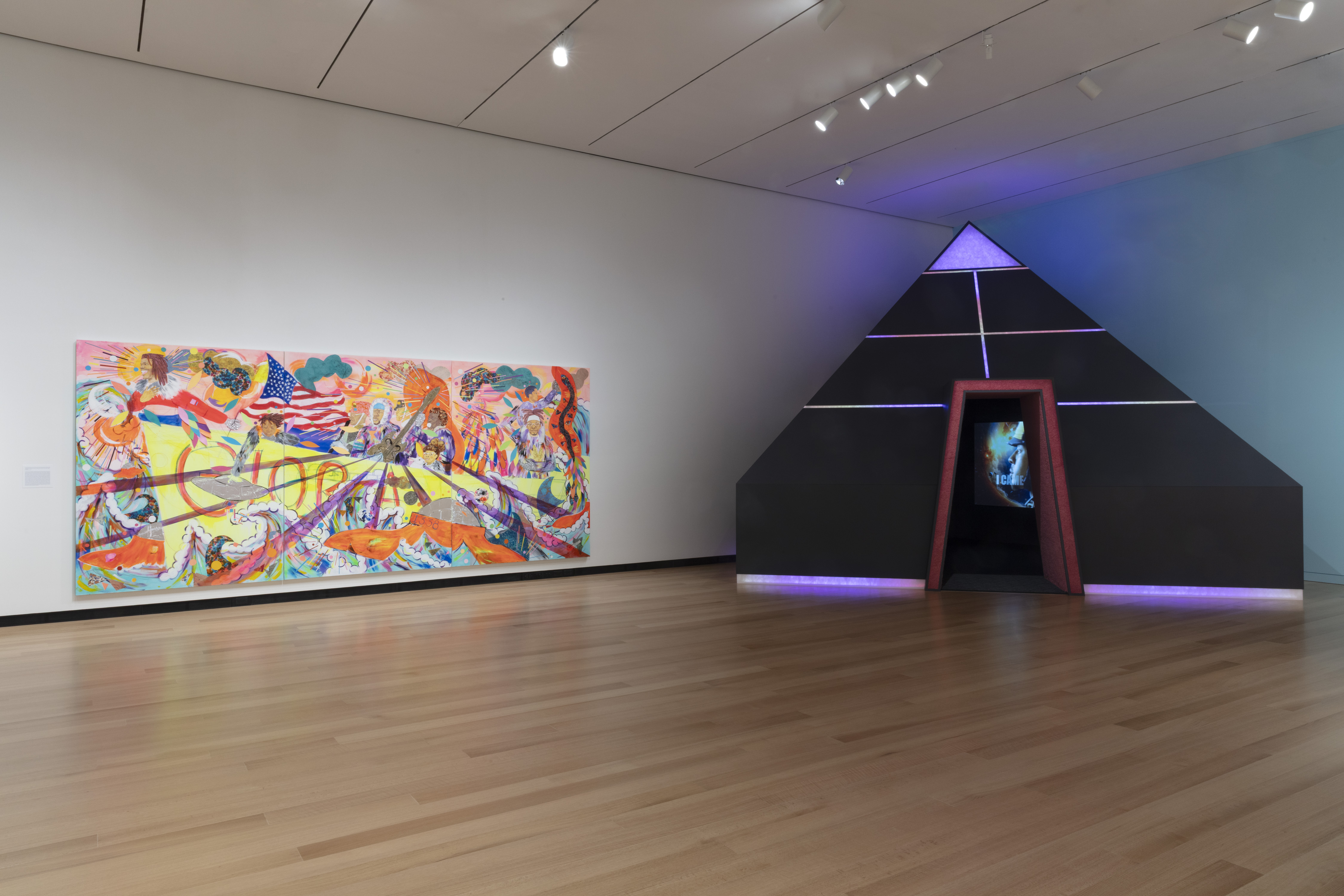
Artworks from left to right: The Mothership Has Arrived!, from the series Another World and Yet the Same, 2025. Ancient Future, 2023. Another World and Yet the Same, 2025.
These works are not just paintings in the traditional sense, they are dynamic mixed media compositions that combine paint, graphite, ink, marker, pastel, glass, jewelry, rhinestones, beads and layers of collage, cloth and bright fabric. A blanket of glitter covers everything with a sumptuous glow and in many of her paintings, sculptural elements such as cloth discs and plushy shapes protrude from the canvas giving them a three-dimensional quality. In the self-portrait Quantum Conversations (2025), for example, a snake-like form drips with cords of color while Edwards stands strong in the middle, her right hand points downward and is wrapped in a white coil that mirrors the sinuous shape above while black orbs pepper the portrait.
As with every work in the exhibition, it takes timeto digest the abundant visual feast that Edwards provides. The Mothership Has Arrived! (2025) is the robust banquet of this juicy show, the veritable climax moment of her epic tale. In this fantastical quasi-mythical three-panel painting, a mighty yellow ship (the “Gloria” in honor of her maternal grandmother) is filled with musicians and children who enjoy a boisterous party on the sea. The main character, Iceberg, smiles at the helm and holds an American flag that flaps in the wind, a band rocks out in the middle of the boat, and a child flies a kite atop a kind dreadlocked man at the stern. Spaceships hover around this allegorical Mothership; a recognition of our abundant universe with alternative beings and ways of being.
The scene brings the title “Another World and Yet the Same” full circle as these merry adventurers embark on an escapade to untold lands. All of this points to the painting Just Keep Going North: Rupes Nigra (2025), featuring Iceberg on his own. In this work, he stands with his back to us as a dark horizon opens into bright realms and four floating cherub faces with rainbow wings anchor each corner as wild whirling blue gestures contain the scene. Given the current situation in the United States, the letters ICE across the back of his jacket (with the subtext ‘berg’ below) both haunts and empowers. Edwards has filled this moment with confidence, and Iceberg’s inquisitive glance in our direction suggests his resolute ambition and determination.
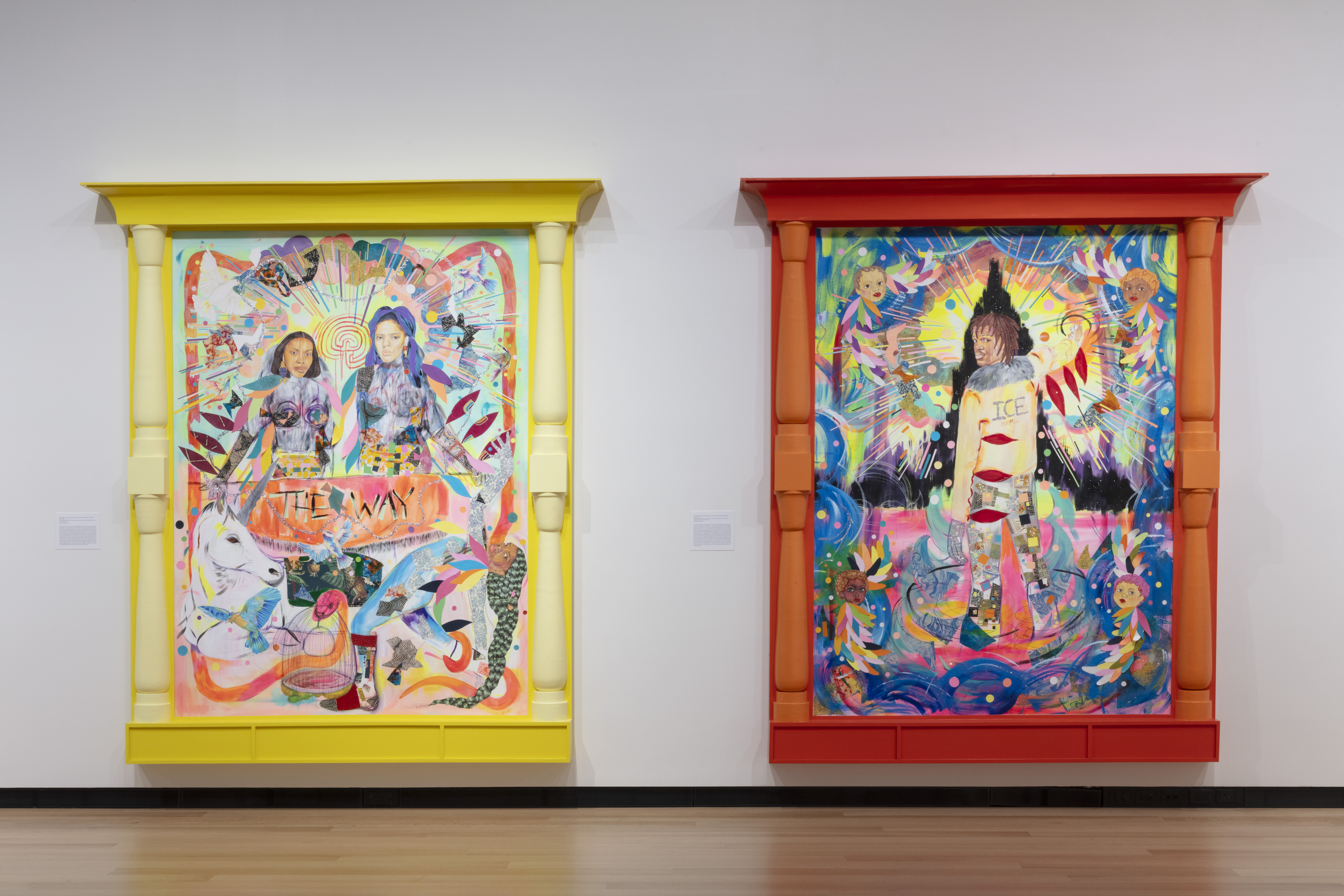
Artworks from left to right: Be Free My Love, You Know The Way, from the series Another World and Yet the Same, 2025. Just Keep Going North: Rupes Nigra, from the series Another World and Yet the Same, 2025.
Two of Edwards’ short video works, Ancient Future (2023) and Another World and Yet the Same (2025), are showcased inside a pyramid-like installation that occupies an entire corner of the gallery. The Afrofuturism-inspired structure welcomes visitors inside to partake in her excitement for movement and musical collaboration. “My mother is a dancer, so I grew up seeing my mom as a woman who is radically and unapologetically free,” she says as she recalls her upbringing. “From a very early age, I had a true sense of sovereignty in my body.” This sense of courageous release is highlighted by the dancers in their regalia, complemented by strong beats. These video works bring together her history has a competitive dancer and her affinity for jazz, soul, Motown, techno, and hip-hop, which Edwards describes as a mix of blues, gospel, and Negro-spirituals.
Jamea Richmond-Edwards’ creative world-building practice is full of raucous bliss that carries us into alternate dimensions laden with symbols that embody diverse themes at once: divine power, female power, Black power, Black culture, family, bloodlines, and the infinite expanse of existence. She asserts a freedom that cannot be contained in this world, or the next. “Artists throughout history have been very intentional about creating space,” she comments. Edwards considers her paintings to be portals to novel spaces within an “inter-verse” of her own design, and indeed her artistic sorcery is more than just that of an artist per say. As says of herself: “I like to look at myself as an alchemist.”
Learn more at Learn more about the Ruth and Elmer Wellin Museum of Art here
Images by John Bentham