




Marissa Jezak
June 11, 2026
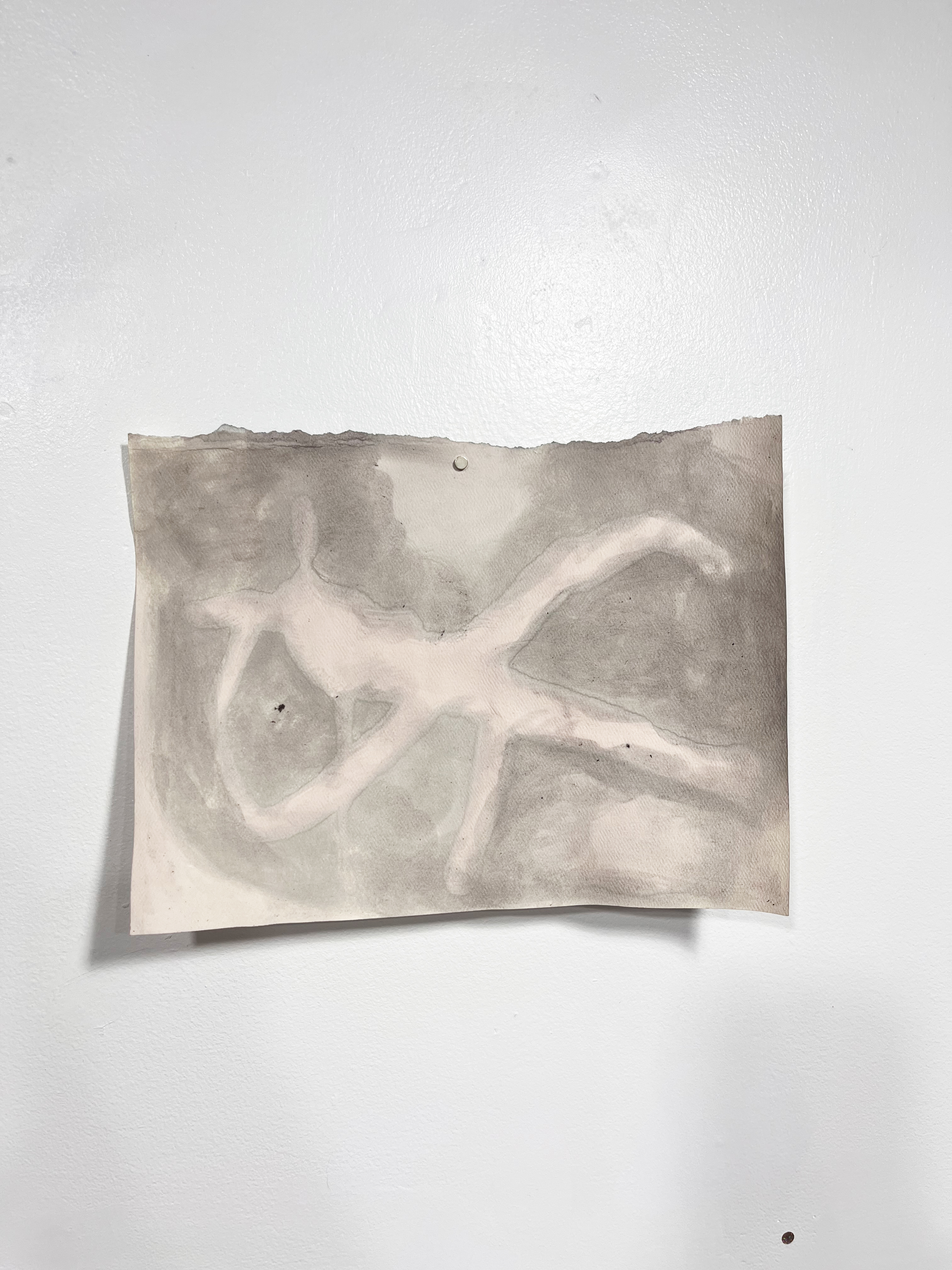
Pink Ribbon
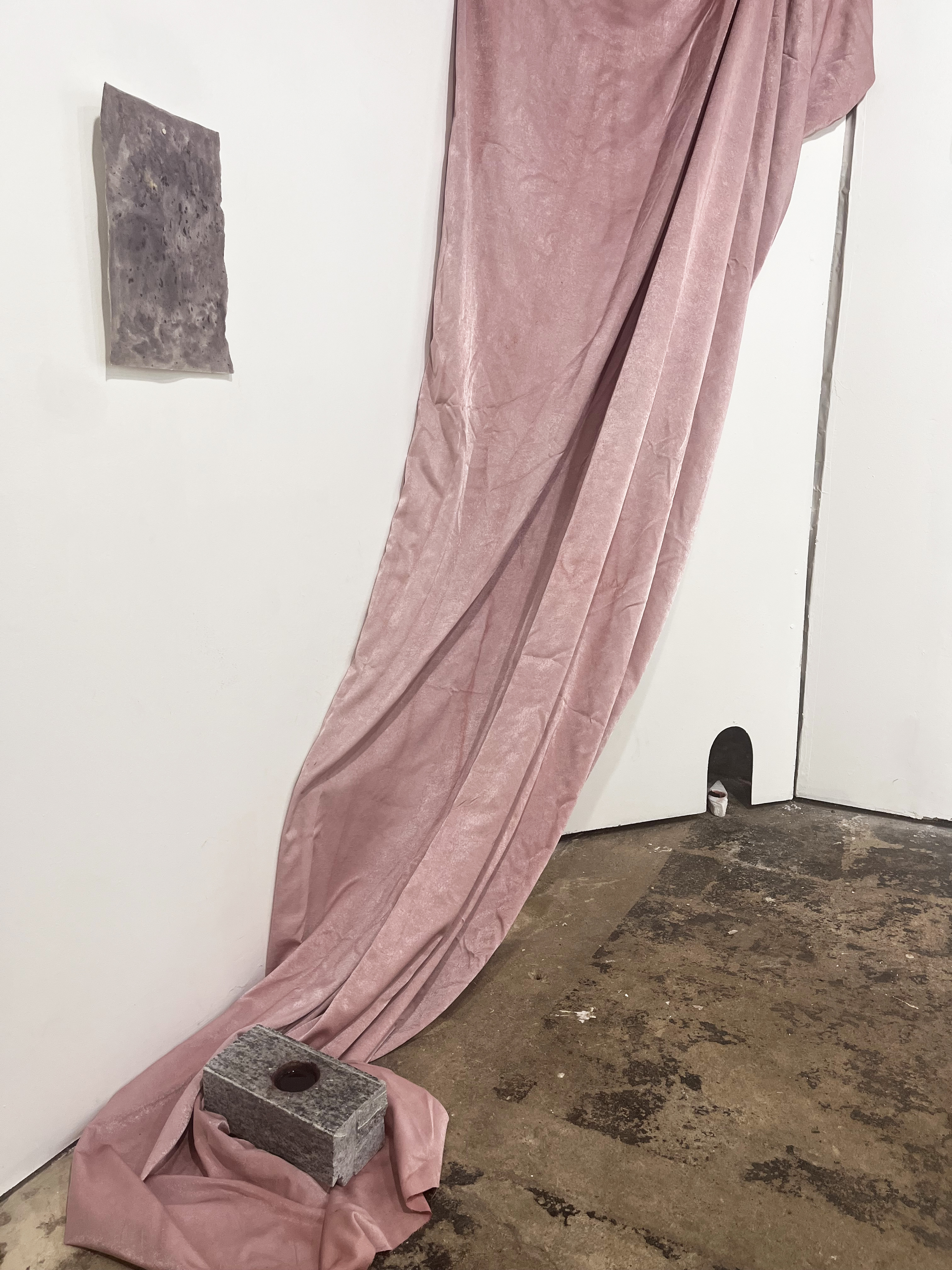
Marissa DeStefano: The purple is mulberry, the pink is beet, and the yellow turmeric. And the dye I used I poured into the stone sculptures, as well as the silk—which is dyed with mulberries.
Marissa Jezak: This looks like blood—are you interested in making it bodily, or intended to mimic blood?
MD: I like the perspectives people might have, or letting it be an unknown substance. Some are more murky, some are more natural. I also think it relates to when you have a spillway with lily pads and it’s very murky, standing water, like a pond. It’s reminiscent of a body of water, a stagnant body of muddy water.
MJ: Can you tell me about the process of the collage works?
MD: They are a blend of found images and images I’ve taken, with photo transfers. Sometimes the transfer doesn’t come out perfectly, but I leave it that way. They started all black and white, but the chemical reaction of the transfer changes the colors—it started creating a lot of blue, purple, dreamlike vibes, and those were on accident. At one point I realized I wanted to make a larger series. I knew what I wanted to an extent, but I also move things around compositionally as I am working on it. And the titles are taken from the words within the collages. Like, “I had a strange dream, you looked like an angel”. It was important that the pieces were hung directly on the wall—I don’t do frames or pedestals. I just want you to see the work.
MJ: What about the title of your show, Bed of Ribbons—can you explain how that came to be?
MD: I was going back and forth with one of my girlfriends and I liked Bed of Roses, that’s reminiscent of an easy life or falsifying this idea that everything’s good, but Bed of Roses is not me…so I ended up at Bed of Ribbons—it references the materials and content in the show, and tied everything in together. Especially this one, that happened by accident, making a pink ribbon—that one heavily influenced the title.
MJ: It’s interesting you were initially thinking about roses because the rose has a much more romantic connotation, where the ribbon is more about adornment or this internalized perspective—which I get the sense that your work is more centered on, instead of a romantic relationship. I think it’s curious how you have two different approaches with the dye vs. the collage, which is much more structured and planned out. It’s kind of like the intentional versus the non-intentional process that you’re separating, but then contrasting them together.
Silk and Stone
MD: When I was making these works, these were two different times in my life. And eventually I figured out I wanted to display them together, so the two veins began to inform one another, and develop as a larger connected body of work. Then there were three components, the dye works, the collages, and the stones.
MJ: The power of three. Does numerology play a role at all?
MD: Not really, it’s more of an aesthetic thing—they tie in together. It’s more about coming full circle.
MJ: With the small marble sculptures, they’re displayed differently, on this structure, almost like an altar. Do you think about these pieces in a spiritual context?
MD: Yes, I’m definitely influenced by spiritual elements, and have incorporated them into my work in the past, using talisman-like objects and bones. Witchy—but spinning it off of my own experiences.
MJ: In your statement you talked about relating your art practice to the experience of dissociation, but you also talked about flow state—I’m curious about that because the way I see it, dissociation is more like a trauma response of leaving the body, whereas a flow state is more about being in the present— they’re sort of opposing, so I’m curious if you see your practice as more of this experience of being detached from the body or more of a grounding experience? Or does it interchange?
MD: Certain things bring up certain things for me—material-wise, the stone, dying the silk, doing the dyed papers, that is more intuitive, whatever shape comes out comes out—I let it run on the paper. It’s more of a flow / letting the material speak more. And then the collages and personal writing brings up more in me. It’s like two separate practices that do different things for me.
MJ: So it sounds like you’re using a non-intentional approach a lot of the time, but your practice can be kind of grounding and dissociative back and forth.
MD: Yes, definitely.
MJ: Your writing also mentioned this idea of “holding onto something, but for what?” I’m thinking about nostalgia, mourning, melancholia… What is it that we’re trying to hold onto? Is it a lost love object, an identity of innocence? And I wonder if the practice is a sort of unconscious attempt at a resolution for this thing? Thinking about it in a more psychological way, is that the main drive behind the work?
MD: There is a physical aspect and a mental part to it—I work a lot with things like the beet juice and mulberry dye, or the scrap stone, where I see something and just want to work with it—exploring the materials in an experimental way. The mental aspect is more like how can I work through this, and get through different points of my day, figuring out how to let things go and not let it affect you so much.
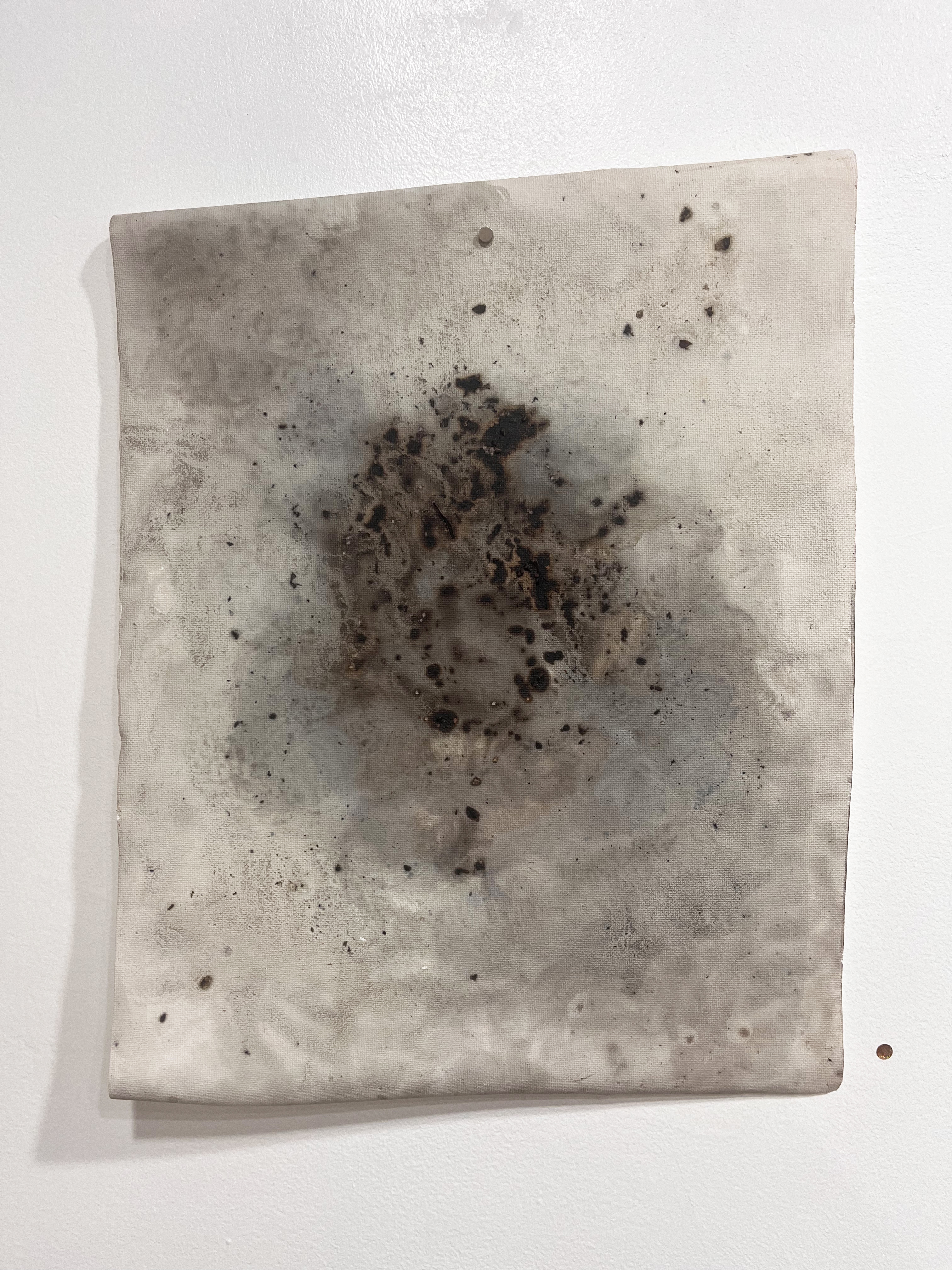
Stolen Innocence
MJ: It sounds like there is a physical holding onto things that is actually a placeholder for something else, and also a letting go. So maybe the holding onto and the letting go is actually working hand in hand? Do you see your practice as a healing process?
MD: Doing this especially with the stone and the dye is definitely a healing process, it’s restorative.
MJ: The weird thing about healing is there’s not really a clear path or a way to measure if we’re making progress, like how do we know what is the end solution? You talk about having experiences of trauma that affect your practice, and I think about if we’re working in this way where the end goal is healing, do we know what it looks like at the end of it? Like you can manage the symptoms or get to the core of it. With your practice, is there an end goal you want to get out of it? Or is it more based on chance?
MD: I don’t necessarily have a goal of what I want to get from my healing. I want to be able to feel more at peace day-to-day, and be more present, and this work allows me to work through the things that don’t let me be present—like the things in the back of your mind. I don’t want to forget about these things and these memories because they make me who I am, but everyday holding on to that or going back to that is too much.
MJ: Memory is really abstract, it’s like this psychic event, something that lives in your brain and is malleable and it has plasticity—we have power over it. The thing about trauma or flashbacks is that we can’t totally control it. Do you think your art practice can be an empowering way to take control over that or do you feel like it’s something that’s out of our control, and the practice is just something we do to manage the symptom?
MD: With the memory thing, It’s like if I wake up on the sunny side of life I’m more drawn to stone carving. But if I’m really beside myself, or down deep I’ll go to the collages more. I like how you said we can’t control it—with me it’s so heavy in smell, like if someone walks in with a certain perfume, it triggers the memory, and I feel on edge.
MJ: A physiological reaction. Have you used scent in your work at all?
MD: With the turmeric and the mulberry—when I’m making it, it has a huge smell. I do it unconsciously—it comes with the material.
MJ: So, you use scent during your process, but it’s not necessarily something that ends up in the end product for the viewer. I can see the trace of the process, but the smell goes away.
MD: Yes, and the works change as time goes on.
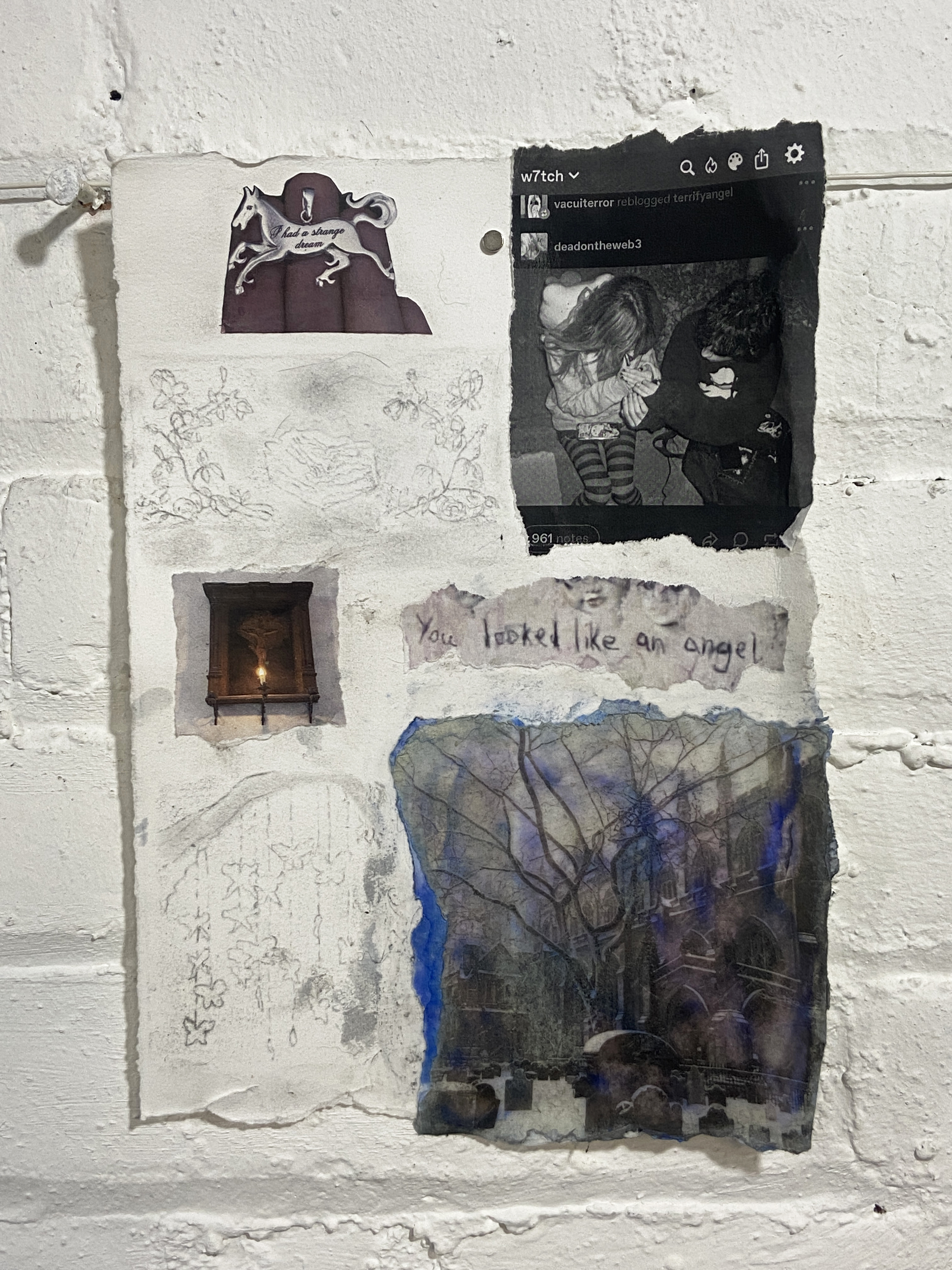
I had a strange dream, you looked like an angel
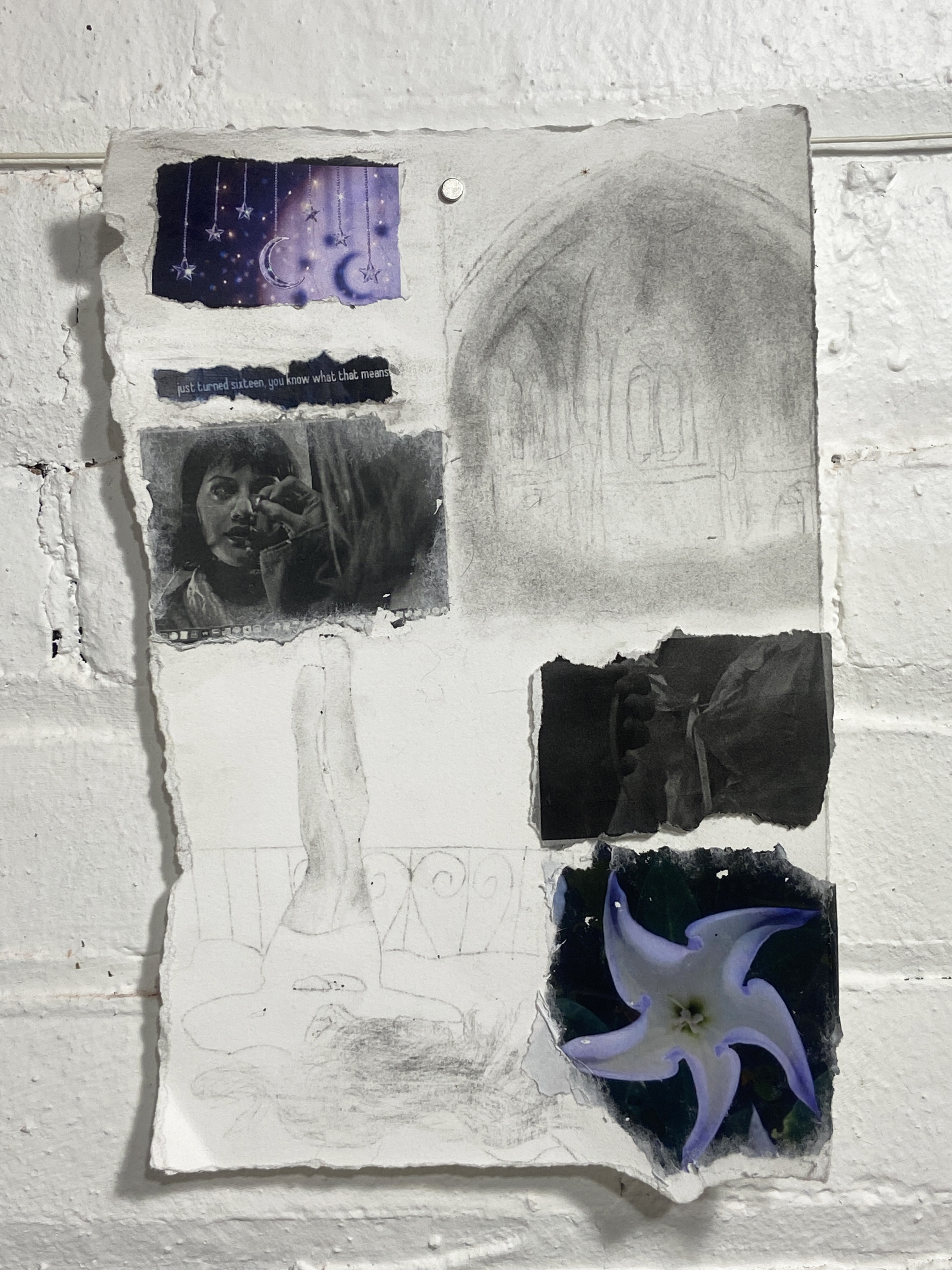
Just turned 16, you know what that means
MJ: No interest in the archival.
MD: Yeah.
MJ: It’s interesting because I would relate your works as more of fitting into a traditional influence—stylistically, what you’re working with. Are you interested in being a part of the traditions of painting, collage, or sculpture? And are there any influences historically or contemporary that you’re really drawing inspiration from?
MD: I love Eva Hesse, Chris Burden, the 60s, 70s throughout the 90s—performance artists that were really going for it. Or install artists like Noguchi, where they’re using natural or traditional materials, but they’re also doing something very new with it, turning it on its head.
MJ: How do you feel that Detroit or your geographic environment affects the art you’re making?
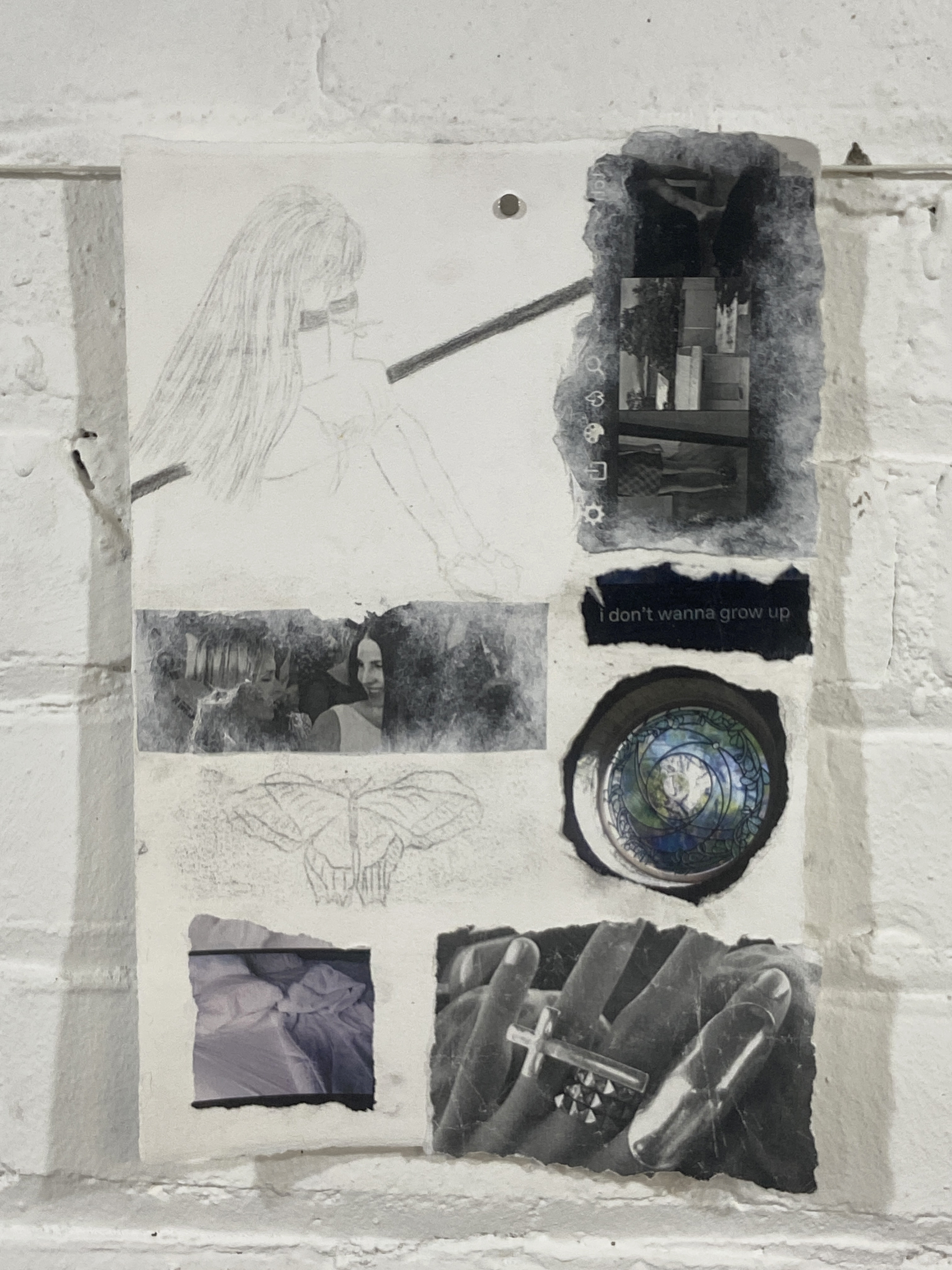
I don’t wanna grow up
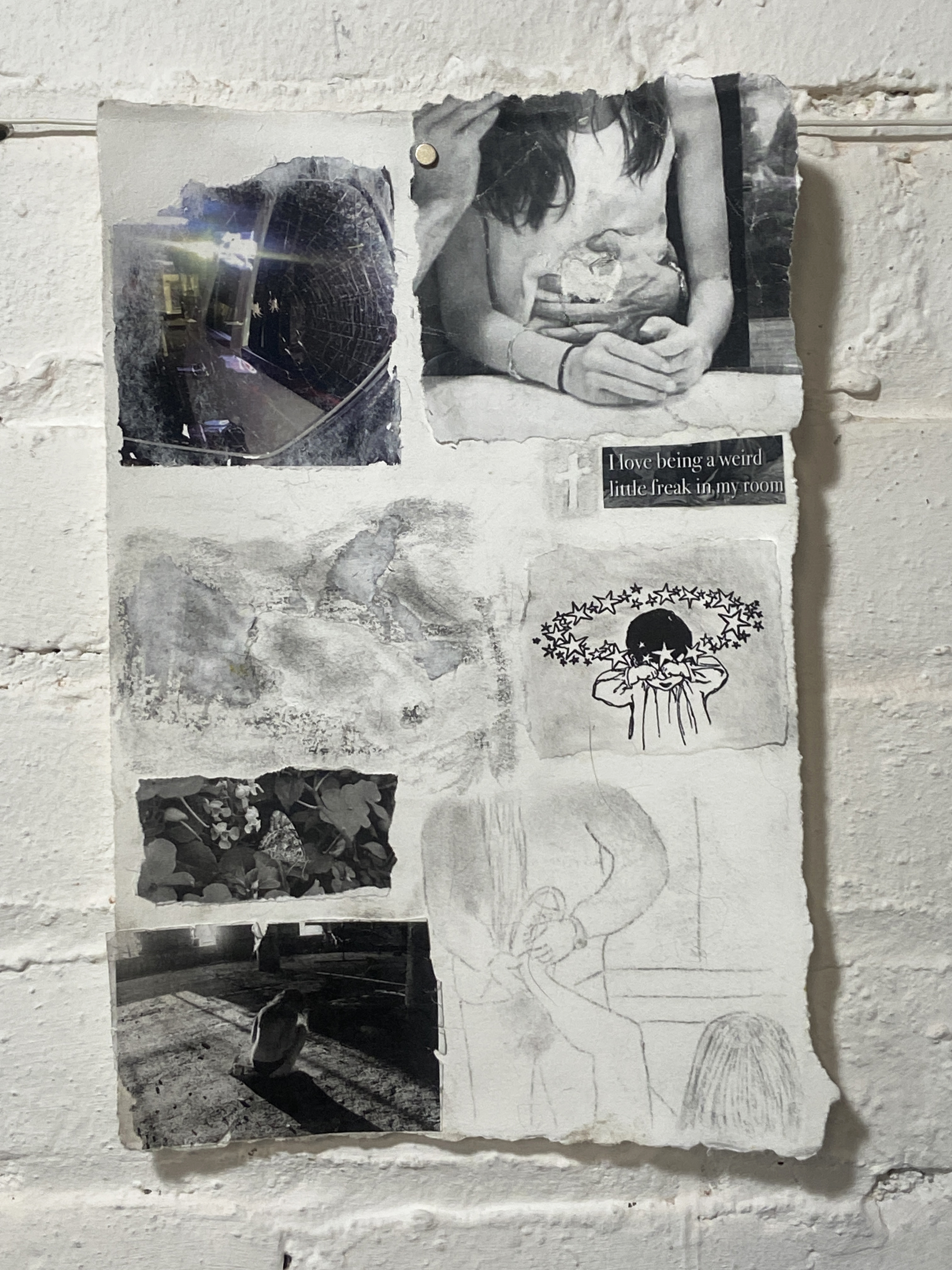
I love being a weird little freak in my room
MD: I feel like what I do always has sort of a grungey vibe, but I also feel like it could be something you could do in a rural area, or on the farm. I like the collaboration that Detroit has with greenery but also an urban vibe, that definitely influences my work. Like with the mulberry works on paper, I would step on the berries when I was walking and I loved the color—that sparked the idea to pick them off the floor and take them home and mess around with them.
MJ: It sounds like you were initially inspired to use the mulberry by your body’s interaction with it. How do you decide how much to put your body into the process? How do you position your body in the work? The feeling of your hand squishing the material or your foot squishing the material, and smearing it onto the page—that direct contact seems important to you.
MD: Yes, like with the ribbon, I delicately balanced it and let the dye flow where it wanted to. And with other works I use my hands. I use brushes for some, but very little. Working with my hands is more fun—I like it more.
MJ: How do you decide how much biographical information to include or not include with your artwork? And do you feel that your gendered experience affects your position as an artist?
MD: I usually don’t include personal information—with this show, I got more vulnerable. I haven’t really ever dived into why I’m doing this work or what it means to me. With this show, I wanted to approach it differently, and kind of start dropping details here and there. This is the most vulnerable I’ve ever been in even bringing up my childhood at all. I like to use it as a space to start conversations with other people who have had similar experiences, building community and making people more comfortable, making myself more comfortable, and shedding light on things—allowing a place to talk about nuanced things that happened out of our control, that some people might not even know. With the gender thing, sometimes I feel very androgynous, but in my head I’m always a little girl—I think about going back to this place of being held, and the frolicking and sense of wonderment. Never lose the whimsy. I think of my little self.
MJ: It can be very dark too though. People talk about childhood in their work in very different ways. It can be very powerful—I appreciate your vulnerability. When you give this personal nugget, it kind of forms a central point for a web, and people are now seeing everything through this lens. You sort of make a bridge to make space with other people and talk about experiences of trauma, which is something that’s so complicated. It’s so important, but it can be so isolating—like declaring yourself a victim is isolating, and if you don’t have other people on your side—you’re alone. You have to bring other people on your side sometimes to help you get over into a space of power, to occupy a space of power in your body. It’s not an easy thing. Once you decide to say something, or fight back, the fight never stops. Do you see your practice as an empowering experience or a way to empower others?
MD: I’m not trying to make waves or anything, but I see it as a platform to be able to talk about childhood abuse. I think it’s important to be able to talk about it.
MJ: Do you feel like it can be re-traumatizing to work through these issues? We talk about art as a healing tool, but sometimes it can get worse before it gets better. Or you have to go down to the depths in order to come out on the surface.
MD: That’s super valid, I definitely feel like that. Some days I just feel like sitting on my bedroom floor sobbing, and working on the collages—it’s like shadow work. You have to look at things and sit with it and try to find peace with it.
Bed of Ribbons was on view at Mouse from April 18th to May 9th, 2026.