




A conversation with Lexi Bishop
May 15, 2026
The city of Pittsburgh was once referred to as “Hell with the Lid Taken Off”1, a phrase coined in 1868 by British author James Parton to describe its smoke-filled industrial landscape of pollution, fire, and soot. But its other name, “Steel City,” properly honors Pittsburgh’s legacy as the mecca of steel production throughout the Second Industrial Revolution in the United States. Like Detroit, industry in Pittsburgh caused a boom in population, growing from around 80,000 to 530,000 between 1870 and 1910 alone!2 People from around the world immigrated there to work for the renowned steel tycoon, Andrew Carnegie, and his company Edgar Thomson Works. By 1910, 60% of America’s steel was being made in Pittsburgh,3 and this industry supported a massive blue-collar workforce that lasted multiple generations. But Pittsburgh started to see a decline in the demand for steel around 1970 as a result of fierce international competition combined with economic recessions from the fuel crisis, and the challenges of working with outdated technology. The decline of demand was followed by a decline in jobs, population, infrastructure and resources. Lexi Bishop, the founder of Middle Node, announced her project in October 2025 as a “Pittsburgh-based digital publication and gallery guide focused on contemporary art in, by, and for the Rust Belt.” She has been working to establish a foundational platform from which a number of resources can grow.
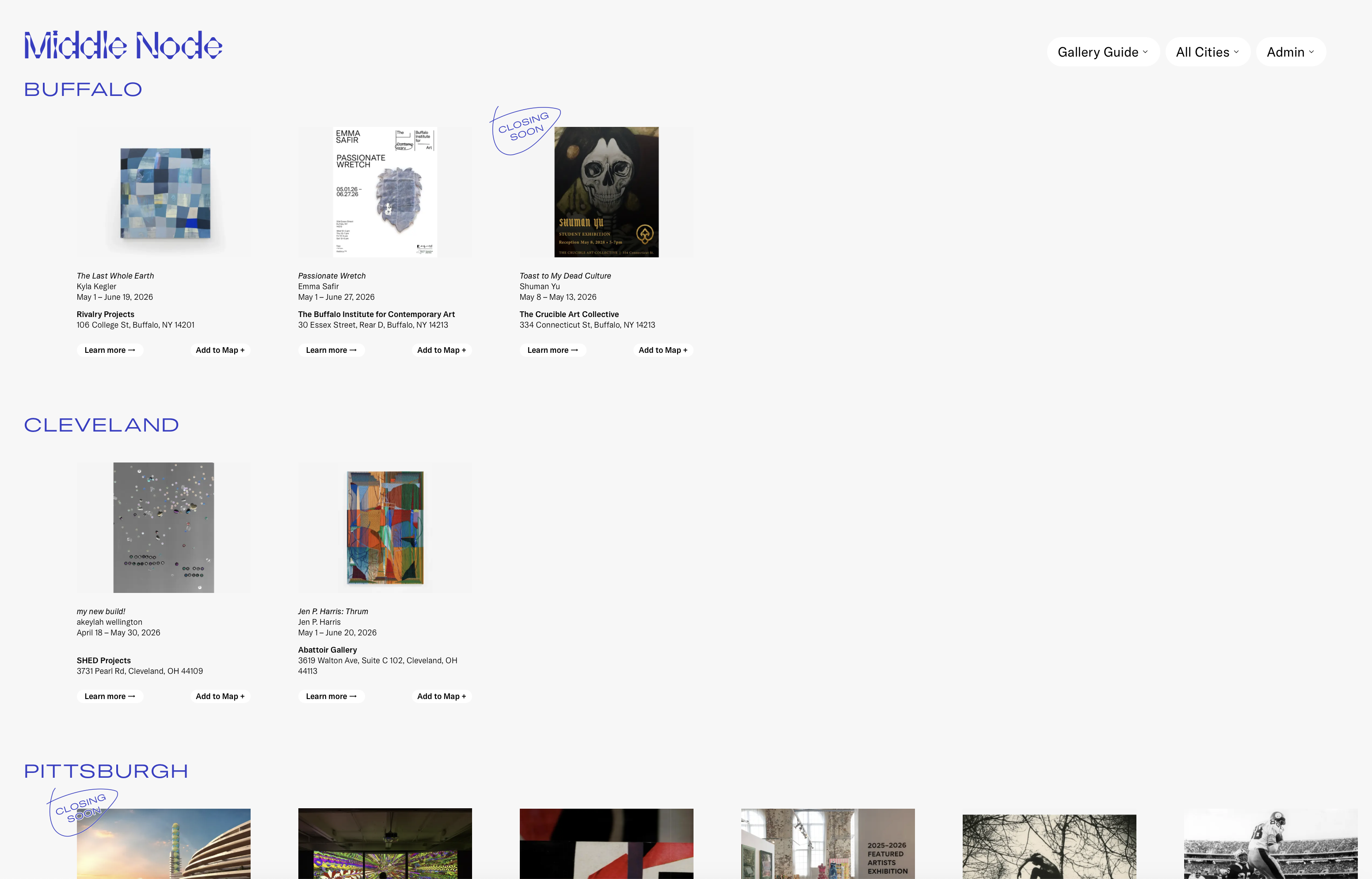
Middle Node’s plan since the beginning has been to connect Pittsburgh with the art worlds of Buffalo, Cleveland and Detroit in order to build a shared system of support and correspondence.
Lexi and a small team, including founding editor, Paula Kupfer, recognized the similarities between these four cities in regards to the scarcity of resources that has come as a result of widespread, long-term, turbulent circumstances. Through editorial coverage, and communication tools like maps, exhibition guides, gallery guides, newsletters and community forums, Middle Node plans to work with visionaries from these places to highlight contemporary art across the region.
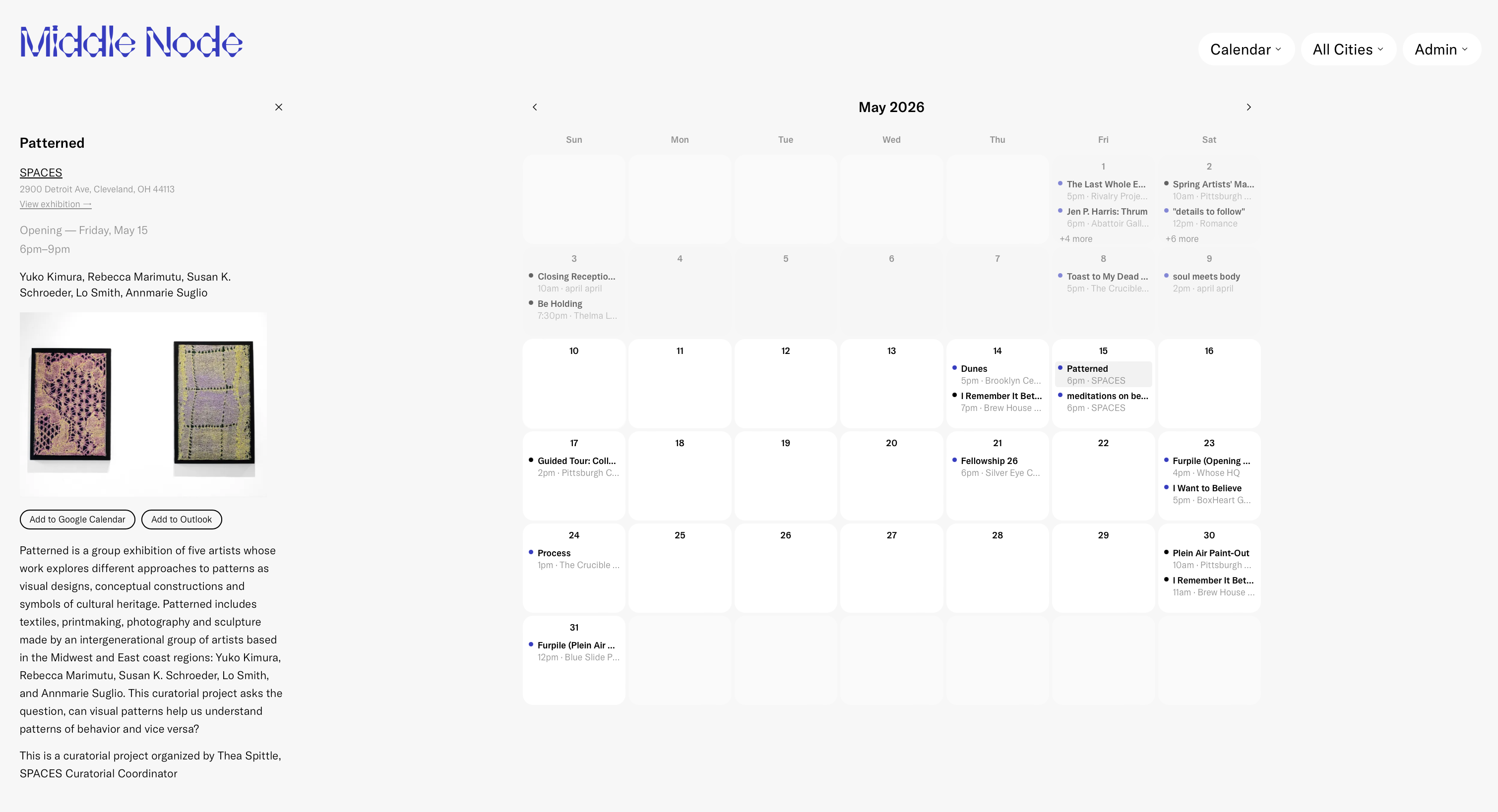
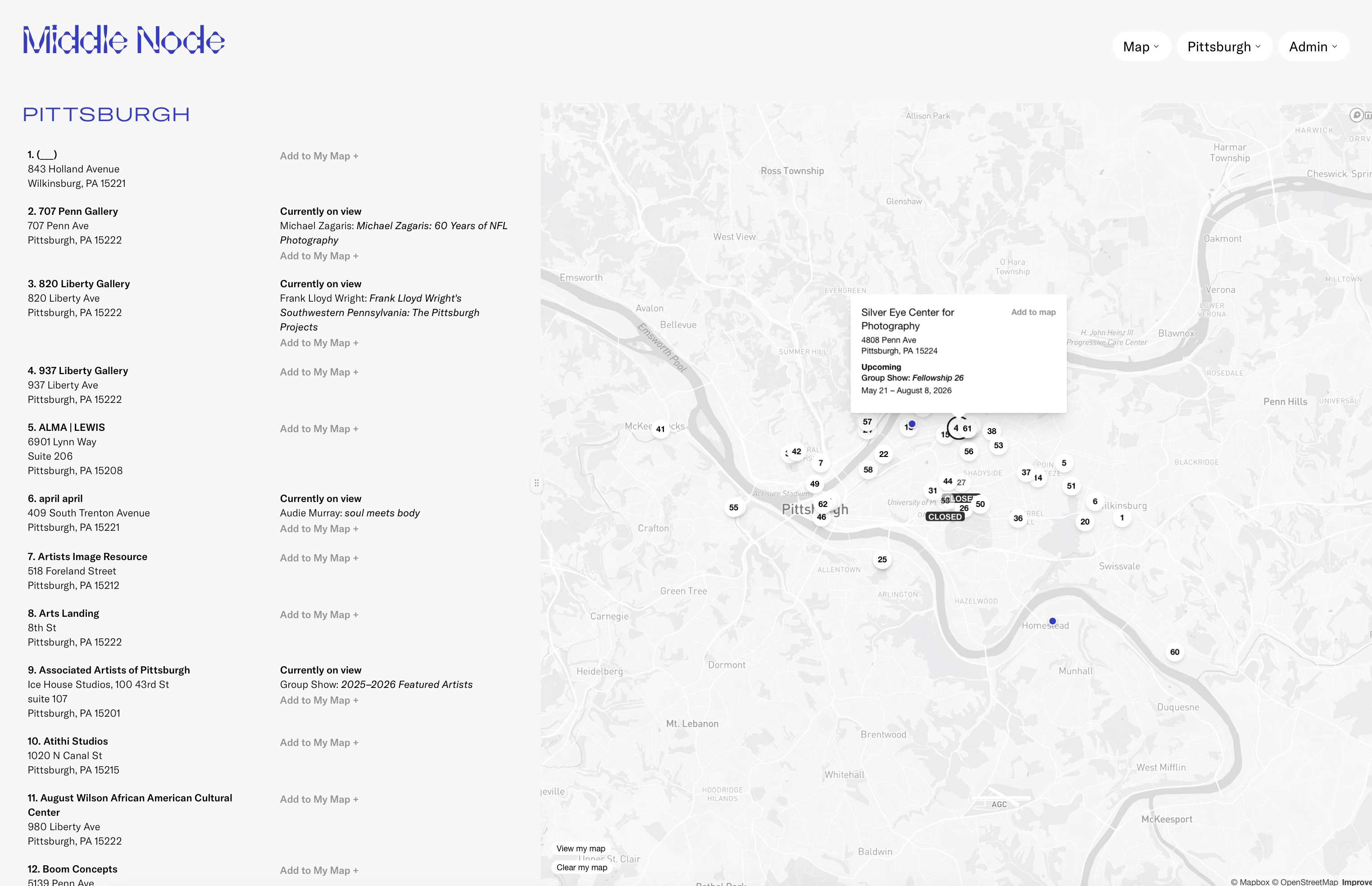
On May 1st, Middle Node launched their gallery guide, which now functions in tandem with the 59th Carnegie International. Visitors of this large-scale contemporary art exhibition have been encouraged by media platforms as acclaimed as Hyperallergic to check out guide.middlenode.info and learn more about parallel exhibitions on view throughout the city.
We had the opportunity to speak to Lexi Bishop about her experience working with the Carnegie Museum and her plans for the development of Middle Node…
runner magazine: It’s great that you were able to launch your project with a map for Carnegie International. How did you end up making that connection?
Middle Node: Yes, so for every Carnegie International, the museum has Program Partners, which are organizations in the community that act as additional resources for keeping the “CI mentality” alive in the city. They’re always trying to have a community component. To start up Middle Node’s partnership with the museum, I approached Dana Bishop-Root, who is the incredible director of education there and also works on forming these community partnerships at the Carnegie Museum. I was telling her about the project and I mentioned that we’re making this guide and a printed map of art spaces in Pittsburgh.
Curators of previous Internationals have sometimes created maps or city guides, but they were often not very comprehensive. So I wanted to offer the map that we were making for Middle Node to be used by the museum. The map is a tool for visitors to learn more about the abundance of art spaces throughout the city, as well as all the exhibitions that would be on view during the opening weekend of Carnegie International. There are currently 60 spaces in Pittsburgh that are included on our map and website. Some of them have never been included in any art guides of the city before.
Outside of the opening weekend of the International, there will continue to be programming throughout the run of the exhibition. In August, Jonathan González will come back to Pittsburgh to perform their site-based, durational artwork called “The Strikebreaks.” And then the International is collaborating with the Pittsburgh Art Book Fair in October. All of these opportunities will give people a chance to learn more about Middle Node.
rm: And how long is the Carnegie International exhibition open?
MN: The exhibition runs through January 3, 2027.Museum groups and other “art tourists” usually come in from out of town to see the show, and sometimes they also visit other Rustbelt cities like Buffalo, Cleveland and Detroit. Part of the idea of Middle Node is to do the same thing we’re doing in Pittsburgh but with these other cities.
rm: So, I guess next you will make a map of Buffalo?
MN: Cornelia Magazine has actually a great printed map of Buffalo that they’ve created.
rm: And that’s through Buffalo Institute for Contemporary Art, right?
MN: Yep! I am hoping that working with Nando Alvarez-Perez, a co-Founder of BICA will help us branch out into the community of Buffalo. Ryan Arthurs and Olivia Mcmanus at Rivalry Projects in Buffalo have also been super supportive of the project I also want to give a shout out to our Cleveland friends Gabrielle Banzhaf and Jon Gott of SHED Projects, Lisa Kurzner of Abattoir Gallery, and Thea Spittle of SPACES for their enthusiastic support of the project. And obviously you, Ashley, our Detroit partner.
On that note, it’d be cool to create an art map for Cleveland and Detroit too.
rm: Yes, we definitely need that… I think one good thing about Middle Node is that, from what I’m hearing, you’re not trying to replace something that’s already there. You’re not trying to colonize the area. You’re trying to work with people who are already there to help build on the cultural infrastructure that already exists there.
MN: Yes, it’s all about forming connections and supporting each other to let more people know what is going on in these cities.
rm: These maps are pretty fundamental to our cultural infrastructure. Detroit is also lacking so much in this area.
MN: In Pittsburgh, things come and go, guides come and go, maps come and go…
rm: Absolutely. I feel like the term “cultural infrastructure” is coming up so much in these interviews that I’m having with people from around the Industrial Midwest.
MN: Like, what is it that can keep a city growing? If you have a foundation that is super precarious, and you keep losing resources that you come to rely on, it can be very hard to achieve the momentum that would allow a community to collectively build a future for that place.
rm: Totally. So back to Carnegie International real quick. Was that your debut as a platform? How was it received?
MN: Yes, it was the debut and I think it went really well! A few of the reviews that were written on the Carnegie International actually mentioned that there was this map available, which was kind of fun. There are many people who are living in Pittsburgh who are on the Middle Node database and using it now. I think once the digital publication launches this summer, it will make more sense about what this is doing for the community and the region.
rm: Once people start to get on board and see that they can go to the same website whenever they are in Pittsburgh, Cleveland, Buffalo or Detroit, Middle Node will become a trusted source for news and information about art in the Rustbelt.
MN: Right and yeah, Pittsburgh’s easier for me because I have established myself in the arts community here already. I realize the other cities will take more time to cultivate.
rm: Could you touch on your background and how you came up with the idea of Middle Node.
MN: Yeah, so I ran a gallery in Pittsburgh from late 2020 to early 2024. Throughout that time, there was no comprehensive calendar that let people know about art things happening in the city. There also was not a lot of press. I mean there really wasn’t any press when I first moved to Pittsburgh that was writing about art. So, I was kind of like, “I want all of these things”.
I was familiar with the SeeSaw app in New York and was wondering if there could be something like that for Pittsburgh. As I spent more time here, and also traveling to Buffalo, visiting Cleveland and Detroit, I was like “oh all these cities are sort of similar, and could benefit from something like this”.
I thought that through creating a platform that could be shared by these various cities would make it stronger and even lead to its longevity. Another element of Middle Node that I am planning to implement is an email ListServ where galleries from these cities can share resources and coordinate across the region.
rm: So, you have launched the gallery guide, and the Middle Node website is live. You talked about doing a digital publication and ListServe. What’s the next step?
MN: Now that the website is live and the gallery guide platform is done, we’re slowly making contact with people in Buffalo, Cleveland and Detroit. As we do that, we would also like to roll out the ListServ and we are starting to think about initial content for the digital publication. Everything is sort of happening all at the same time.
rm: Do you have a background in business?
MN: I mean, before I moved here, I was working as a director at a gallery in LA. It was a small gallery, so I got to be kind of a part of everything. I worked on sales and artist relationships, but also helped with shipping, invoicing, connecting with the press, writing press releases; I really saw how all the components together made the gallery work, which of course helped when I ran my own gallery for three years And before that, I was at Christie’s, the auction house, which, you know, involved contracts and clients and things like that.
rm: What’s your educational background?
MN: I got my undergrad degree in Art History and Russian at a school just outside of Philadelphia, and then I did the Christie’s Master’s program, which was focused on the history of the art market and modern & contemporary art.
rm: So, you’re in Pittsburgh now but you’re from Philly?
MN: Well, we moved around a lot when I was younger. I went to high school in Connecticut, then I went to college outside Philadelphia. Then I moved to New York to complete the Christie’s master’s program. I was there for 10 years, then went to Los Angeles and moved to Pittsburgh from LA.
rm: What made you decide to move to Pittsburgh from LA?
MN: At the time, I was dating someone from here, and when the pandemic started, he wanted to go back to Pittsburgh. I came to visit and immediately fell in love with the city. I’ve never lived in a place like this. The landscape here is so uniquely beautiful, with all the lush hills and rivers alongside its industrial history.
There is also so much energy here. It felt exciting, and it felt like people were starting things. You don’t necessarily have to come from money to make things happen here. I hope to one day have a situation where young artists didn’t feel like they had to leave Pittsburgh to have sustaining careers or opportunities, but maybe that’s already happening?
Middle Node is named after the points at which lines or pathways intersect. In astrology, the middle node refers to the midpoint between the North and South nodes, representing a crux of balance and integration.
Lexi Bishop, the Founder of Middle Node, completed her Bachelor of Arts degree in Art History and Russian Language from Bryn Mawr College, and a Master’s degree in The History of Art and The Art Market: Modern & Contemporary Art from Christie’s Education. From 2020 to 2023, she ran a small contemporary art gallery in Pittsburgh called ‘here.’ Prior to opening the gallery, she worked as Associate Director at Nino Mier Gallery, Los Angeles, and as a Specialist in Post-War and Contemporary Art at Christie’s Auction House, New York.
Paula Kupfer is a Pittsburgh-based art historian and former Managing Editor of Aperture Magazine, will serve as Middle Node’s inaugural Editor in Chief, stewarding established writers and new voices as they engage with the region and beyond. More city-based representative editors will soon join the force. Kupfer completed her PhD in the history of art and architecture at the University of Pittsburgh, and her MA in art history at Hunter College, New York. Her writing has appeared in ASAP/J, Hyperallergic, Terremoto, The Photobook Review, Harper’s “Postcard” blog, BOMB online, TIME LightBox, and the Aperture blog, among others.
You can learn more about Middle Node at here, and on Instagram: here.
Learn about Carnegie International here.
And the Pittsburgh Art Book Fair here.
1. Newton, Matthew. “Hell with the Lid Taken Off.” Oxford American, March 25, 2014. Link.
2. Schwab, Andrew. “The Collapse of Pittsburgh Steel.” ArcGIS StoryMaps, April 25, 2023. Link.
3. Schwab, “The Collapse of Pittsburgh Steel”.