




Wyatt Thiry
June 16, 2025
The purpose of this essay it to use the writing of German philosopher Gotthold Ephraim Lessing as a foundation for a modern criticism on the new consumerist nature of art as complete immersive inclusion. In Lessing’s writing titled Laocoon, he opens with a fictional narrative structure centered around three characters, which is emulated in Mirroring Laocoon. Lessing, throughout his writing, advocates for the power of imagination in works of art. This case still holds true today, but in a way that is disserviceable to art as a whole. Our modern approach is to need to be able to imagine ourselves in all art that we see, and that if encountered art is not catered to our own individuality, it should be dismissed. Mirroring Laocoon seeks to examine this reality through the lens of Lessing’s writing, which is to say to establish a modern view on art philosophy by examining the views of the past.
“Lessing confronts his readers with a text that remains entirely opaque unless one enters a critical dialogue with it... He stages the argument of his text in such a way that his readers are provoked into exercising their capacity for critical reasoning.”1
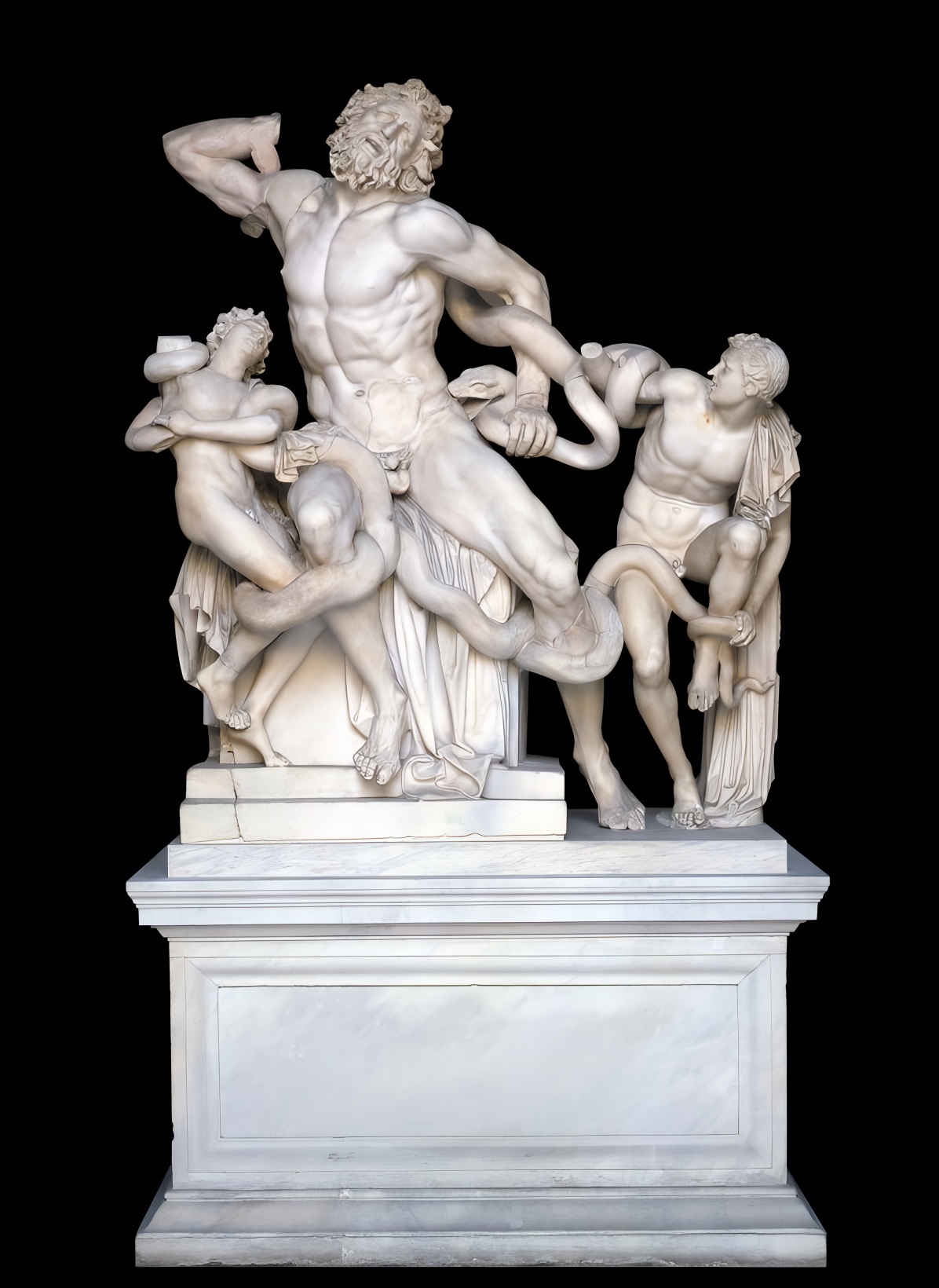
Fig. 1
Preface
Thanks to the vast scholarship surrounding Gotthold Ephraim Lessing’s Laocoon: An essay upon the limits of painting and poetry. With remarks illustrative of various points in the history of ancient art (shortened as Laocoon), I find it imperative that my writing surrounding it does not follow in the same thread as has been done. The most productive output, I found, in reading Lessing’s work and subsequent analyses was that I too might write a Laocoon, following the threads of critical and theoretical analysis that are ripe within the work. My approach to Lessing’s work may seem utilitarian in this way, and in a sense this is correct. I’ve encountered a work that can so distinctly stand on its own two feet, and in my desire to do the same, the Laocoon will be taken as a sort of guide for critical analysis of some shred of the art world, as I see it. This approach will have ramifications on the structure of this writing, as it is not intended to be wholly analysis, commentary, criticism, or research, but as a synthesis of all of these with creative writing, as is Lessing’s own work. In this alternate structure is where the mirroring begins.
As he starts his Laocoon, I will start with a narrative, depicting three different persons experiencing evolving encounters with media.2 This will then transition into the proverbial ‘getting my ducks in a row:’ establishing a basis for the following loosely structured criticality using examples from Lessing’s own work and scholarly analysis concerning it. Doing so will allow me to write critically in a more free flowing, stream of consciousness manner that best suits the nature of my critical thought. I feel that this approach is founded, as Lessing’s own writing is organized in a personal voice which prioritizes the readers own interaction with and interpretation of the work, as Mücke illustrated in the quote above.
I will follow Lessing further by including his own provisional quote, which ends the preface of Laocoon, as well as a quote from Clement Greenberg which serves the same purpose. Perhaps if Lessing and Greenberg are connected in supporting their desire to speak freely through provisions, I may be able granted the grace to do the same:
They [the following observations] have arisen casually, and have grown to their present size rather in consequence of the course of my reading than through any methodical development of general principles. They are rather irregular collectanea...Yet, I flatter myself that, even as such, they will not be wholly despised.3
All the essays are of course informed with a particular outlook, and therefore remain provisional. The conclusions they embody, no matter how deliberately arrived at, remain open to revision and modification, not only in detail but also in principle.4
I. Introduction to Conclusion
The first person who saw an image recognized that the image was not of himself. He saw it, remarked that they, in their likeness, were different. It felt good to him that someone might look different, so that some people might find him the more beautiful of the two.
Through his comparison, and without knowing, he had given the image a life it never should have had. He turned it into a real person onto whom equal judgment is passed. A second person sought to analyze the same image. To see why and how it was different; to judge if the differences were realistic, hoping that there would be a technical inadequacy to judge. They looked and scrutinized and were left wanting, as the image had perfectly depicted what they came to expect. Because of this the second person deemed it indistinguishable from the real, and thus created a new life from the same image: a life built on the mirror. A third person, who reflected on the perceived value in the image, deemed that it did not fit the agenda. It was inconsiderate of all sides, not marketable, and without a shred of the ‘raw’ or the ‘punk.’ There was no way to post it, or share it, or to remix it. The image simply stared back, not blinking (or with its eyes closed?) offering no escape. Through disdain, the third person created a life yet again, through hatred.
The first was an artist; the second was an artist; the third was an artist.
Each saw the image, thought about the image, and desired the image in their own way. It felt new to each of them, and an enemy to all of them, but an enemy they desired to use for their own devices. Maybe someday the three will meet and ask each other: ‘why did we have expectations of the image in the first place? As people (all art aside), can’t we think of something better to do?’
In the Laocoon, Lessing argues that the image should be imagined. The ‘pregnant moment’ is described as the removal of detail to just the right point where the highest passions of the work can be interpreted across all axis:
When Laocoon Sighs the imagination may hear him scream; but when he screams, then it can neither advance a step higher in this representation, nor descend a step lower with out holding him in a more tolerable and therefore in a less interesting condition: you either hear him groan for the first time, or you see him already dead.5
In the plastic arts, as he describes, where a single moment is the subject, the artist must choose the perfect balance between rising action, climax, and falling action to allow for “...the most fruitful free play of the imagination.”6 This corporeality of time and its relation to image is present throughout the Laocoon and is referenced heavily in the scholarly research surrounding it. Lessing himself describes the relationship between the image and mental/physical moment experienced by the viewer:
...that point at which the observer not so much sees as surmises the crisis, with that phenomenon with which we do not so necessarily connect the idea of the transitory, as to render the prolongation of displacing... our imagination goes far beyond what the painter has been able to draw in this terrible moment.7
Though this quote deals with some image depicting physical crisis, it pertains to all aspects of conveying imagery through plastic media. The control of the viewers imagination is power.
This emphasis on factors of time in the visual relationship of media is described by Jeoraldean McClain in her essay “Time in the Visual Arts: Lessing and Modern Criticism.” In this writing, McClain confirms that the nature of time through imagination as described by Lessing and Rudowski is the driving force behind the cubist process. This process is different, however, as it does not offer the imagination and image immediately imaginable or obtainable, but “... a composite time of fragmentary moments without permanence or structural continuity.”8 This is furthered in minimalism, McClain claims, where time is essentially removed as an aspect of composition. The time experienced through the work is not from the work, but the time placed into the work by the viewer.9 The minimal has no relation to the suspended pregnant moment as described by Lessing. It simply does not acknowledge time as a factor.
If this time is a product of subjective experience of space (in relation to a work of art), is not the time stamp given to the pregnant moment also subjective? The arbitrary time displayed in an image (for Lessing, the scream turned to sigh in the statue of Laocoon10) is as arbitrary as time experienced outside of the image. At this level of viewer-time-interaction, the nature of the image itself and the signs it contains becomes apparent: “Signs, precisely because they are arbitrary, can express all possible things in all their possible combinations.”11 Through the work of these scholars, the temporality in the expression of Laocoon as Lessing describes has itself become temporal.
Now that the groundwork has been laid, this writing will conclude with an emulation of the quote from Mücke. A contribution to a critical environment will be made. In my approach, however, I will not make any attempt at an argument or answer. This will only serve as a posing of questions, based on analytical observation of the world around me and thoughts that have arisen through the research done to form the basis of this writing. Additional quotes and references to the specific research will be made to stitch together these apparently incohesive thoughts.
II. Compulsory Conclusion
Has time become more or less of a factor in our modern interaction with images? Whereas Lessing states a desire for the pregnant moment in art as a need to obey the first law of art being beauty,12 the modern necessity for time feels different. Granted, escapism was surely prevalent in the 19th century as it is now, but the modes of seeking and obtaining this fix have shifted drastically. We have access to all documented forms of art and media across the entire scope of human existence at our fingertips. With such access to all things, and especially to all things art, it seems as though the hovering moment of beauty in the Laocoon no longer exists.
Art is consumed as media. Paintings need to be portals or else they are not paintings. The characters depicted in media must represent us, or they are our enemy. If we cannot see ourselves inserted into fictional worlds, hysteria ensues. The need to live vicariously through works of art and media is what drives the desire to experience it. Not to experience it in the sense of being in its proximity, but to become the art’s proximity. If the art cannot be me it should not exist.
The life made from the enemy, from the mirror, from the hatred is not made for these things consciously but through our unconscious desire to experience anything but what we are experiencing now. Perhaps this is what connects this need for escapism to the past: things go wrong at all times. The state of life is never ideal, and never will be. “Life is suffering.”13 I can imagine art always reflected this, but the immediacy and desire for recall at all times of this escapism today is what feels markedly different.
The strangest thing is that the statue of Laocoon is still held to be so beautiful even though it embodies this temporality that is so contrary to our modern environment of avid art consumption for escapisms sake. Perhaps there will come a time in the future when even the ancients are despised for their inability to make art that we can insert ourselves into fully. When virtual reality comes full circle, maybe there will be a program to live vicariously through Laocoon and be devoured by snakes.
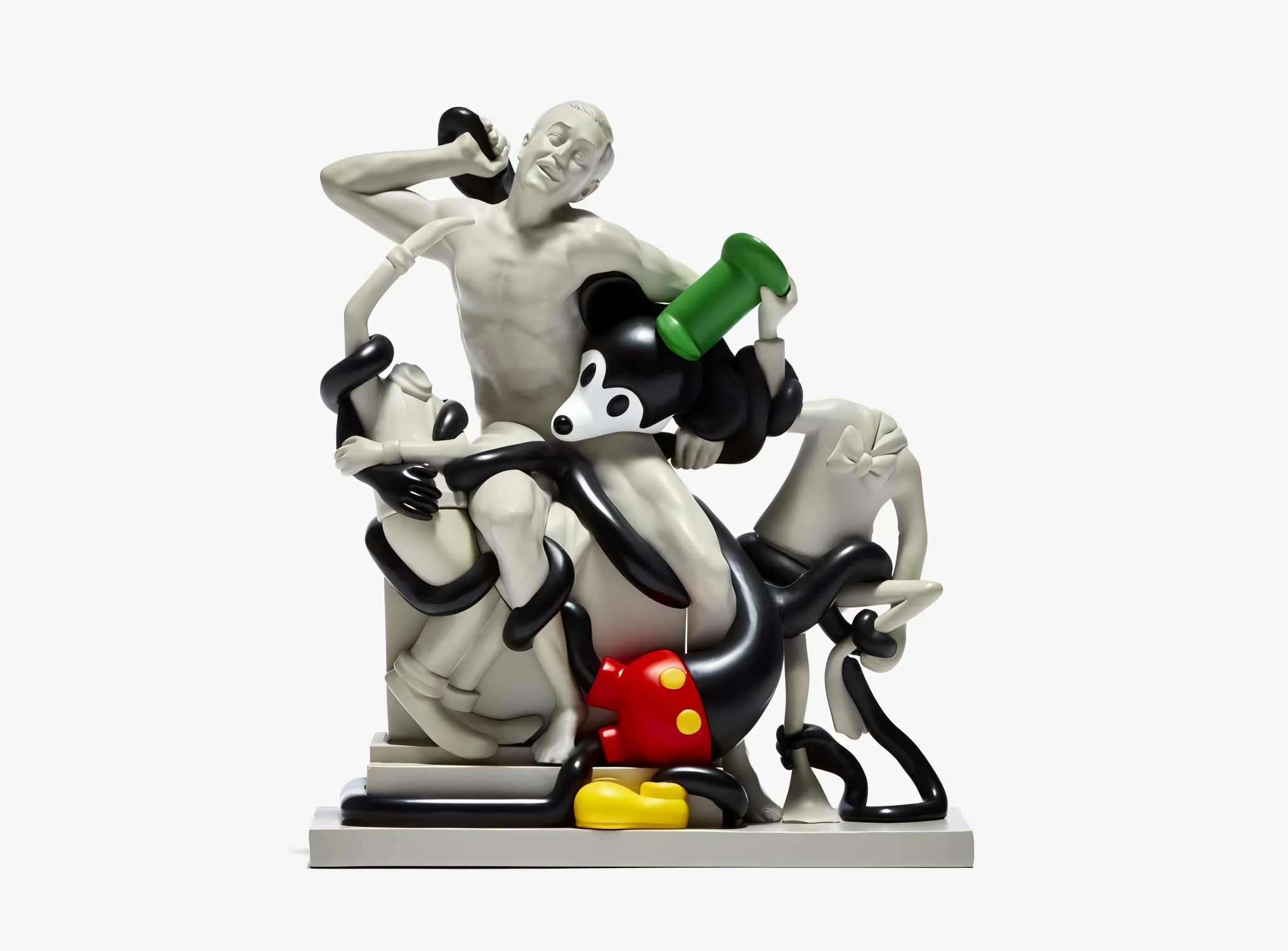
Fig. 2
Being aware of the formation of critical structures and their formations of the past allows us to more eloquently address the perceived problems of the now. Considering temporality in the interaction with the viewer is a thing, a possibility. Whether I choose to ignore it or not within my actions is my prerogative, but it is a prerogative I did not know existed (in the way Lessing described) until now. The purpose of reading and writing in the way Lessing did and as I hope I have done is to connect these disparate elements with each other, so that maybe the view of the work is more all-encompassing with regards to the then, the now, and the later. This is the utilitarian approach I saw possible when reading Lessing: that critical thought and analysis is the best course and the most applicable tool for asking the questions of what to make and why.
1. Dorothea Von Mücke, “Authority, Authorship, and Audience: Enlightenment Models for a Critical Public,”Representations, Vol. 111, No. 1 (Summer 2010), 70.
2. Gotthard Ephraim Lessing, Laocoon: An essay upon the limits of painting and poetry. With remarks illustrative of various points in the history of ancient art, 55-56.
3. Lessing, Laocoon, 57.
4. Clement Greenberg, Art and Culture: Critical Essays, 5.
5. Lessing, Laocoon, 71.
6. Victor Anthony Rudowski, “Lessing contra Winckelmann,” The Journal of Aesthetics and Art Criticism, 1986, 237.
7. Lessing, Laocoon, 72.
8. Jeoraldean McClain, “Time in the Visual Arts: Lessing and Modern Criticism,” The Journal of Aesthetics and Art Criticism, 1985, 48.
9. McClain, The Journal of Aesthetics, 50.
10. Lessing, Laocoon, 71.
11. Cecilia Sjöholm, “Lessing’s Laocoon: Aesthetics, Affects, and Embodiment,” The Nordic Journal of Aesthetics, No. 46 (2013), 22.
12. Rudowski, “Contra,” 237
13. Bhikkhu Bodhi, The Connected Discourses of the Buddha: A Translation of the Samyutta Nikāya, 1844.