




An interview with Meredith Fleischer
October 19, 2026
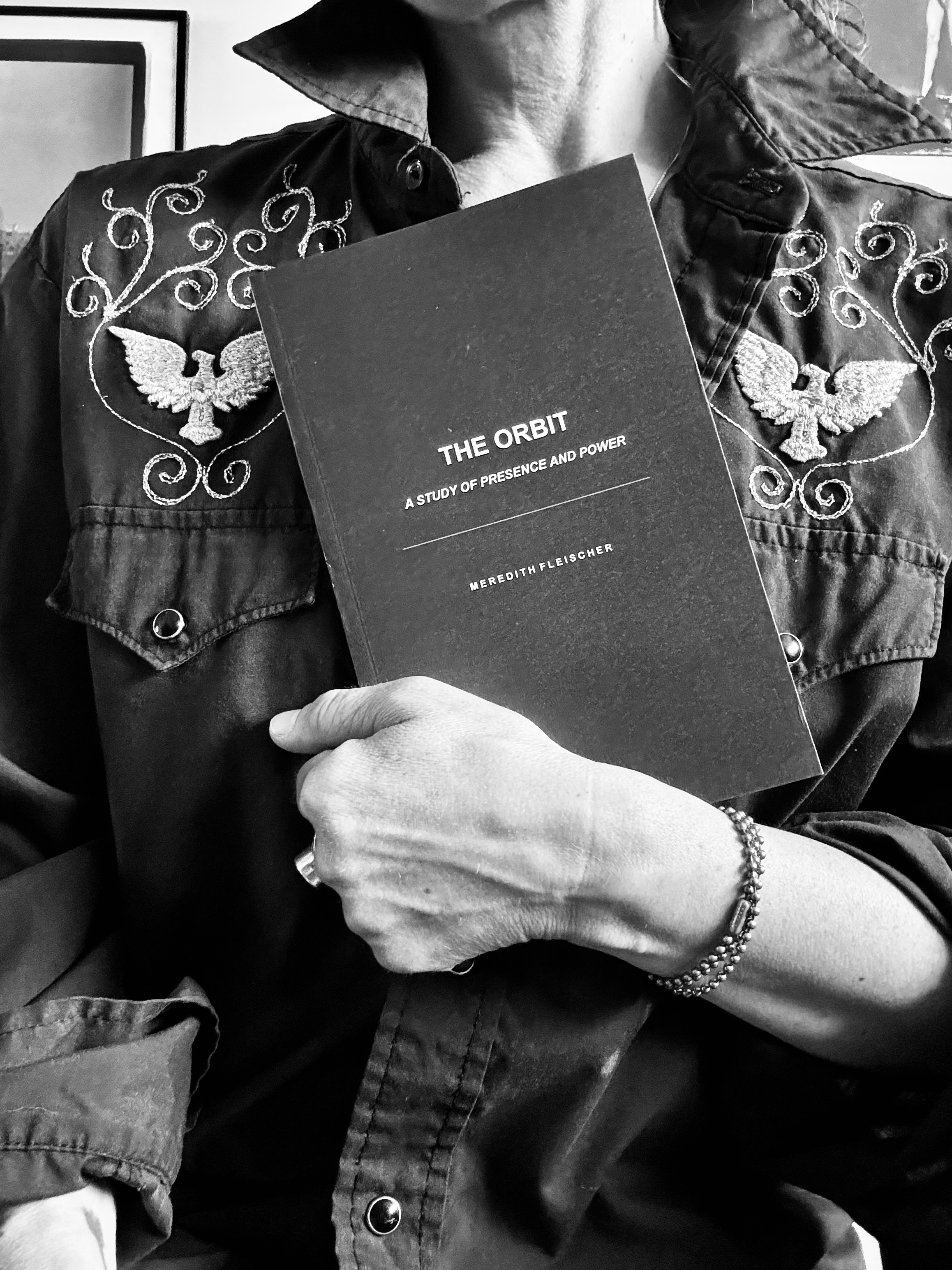
We are approaching thirty years since AOL Instant Messenger entered our world as one of North America’s first digital chat tools, allowing individuals to socialize in real time without the need for face-to-face interaction. It was likely understood at its onset that AIM would dramatically alter human connection as we move into an increasingly digital future, but only through lived experience could the psychological impact of disembodied relationships be revealed. THE ORBIT: A Study of Presence and Power is a nonfiction novella written by Meredith Fleischer, who describes it as a “forensic narrative of a twenty-two-year trajectory, mapping the space between signal and silence and the subject’s return to their own gravity.” This description poetically describes a process of self-discovery anchored by the memory of her long-time partner, followed years later by a chronically anticlimactic online digital entanglement. In hindsight, Fleischer understands that each of these relationships occupied opposite ends of the spectrum of emotional intimacy: one rooted in closeness, trust, and vulnerability, and the other marked by surface-level conversations and emotional suppression. The stark contrast between the two, along with their close temporal proximity, induced feelings of confusion, stress, profound isolation, and an erosion of her sense of self.
runner magazine: Planetary orbits, presence, power… can you dive into your use of language and metaphor when deciding on the title of your book?
MF: THE ORBIT refers to gravitational fields, specifically how an object can be caught in the pull of something that offers no real center or warmth. In astrophysics, an orbit is a path of perpetual falling around a body that never makes contact. Metaphorically, it maps the modern phenomenon of digital “presence” without actual vulnerability. “Power” enters the equation when you recognize that remaining in someone’s orbit is a choice, and reclaiming your own gravity requires total energetic disentanglement. The language throughout the book is forensic because I wanted to treat the trajectory not as an emotional melodrama, but as an evidentiary study of signal versus noise.
runner magazine: THE ORBIT is a chronological archive of your experience with unconditional love, which was followed by regular encounters with an individual’s obsessive, yet superficial attention online. Why did you feel that this very personal story was important to release for public consumption?
MF: I did not publish THE ORBIT as a personal tell-all; I published it as a limited-edition artifact because I had to get the story outside of me. I was living in the shadow of two hauntings: the death of my late partner, Chris, an accomplished musician, and a living distraction online—a public figure who reversed the parasocial script by seeking out my space first. Releasing this book was about reclaiming my mental landscape. I wrote it so the ghosts would finally have a last page. On a broader scale, this specific experience functions as a micro-case study of a widespread cultural condition. Millions of people are currently participating in disembodied, phantom relationships, mistaking digital accessibility for actual intimacy. By contrasting a deep, six-year lived bond grounded in real-world presence against the hollow mechanics of digital orbiting, the book exposes the illusion while serving as a structural mirror for anyone navigating modern digital intimacy and self-sovereignty.
rm: On a broader scale, do you think that this book potentially touches on the psychological impacts of “love bombing” and “breadcrumbing” ?
MF: While pop-psychology terms describe surface behaviors, THE ORBIT looks at the structural anatomy of the dynamic. These behaviors thrive in digital spaces because the screen acts as a buffer against real accountability. It is not just about someone giving “crumbs”, it is about the psychological trap of living in projection rather than reality. The book focuses on the moment of recognition: when you stop analyzing the other person’s tactics and instead examine why you allowed a phantom presence to occupy space in your life in the first place. Reclaiming that space meant establishing a definitive boundary, but it also marked a profound shift toward healing. It allowed me to integrate the trauma of Chris’s death so that instead of guarding his grave, I could finally bring his memory forward with me into the future.
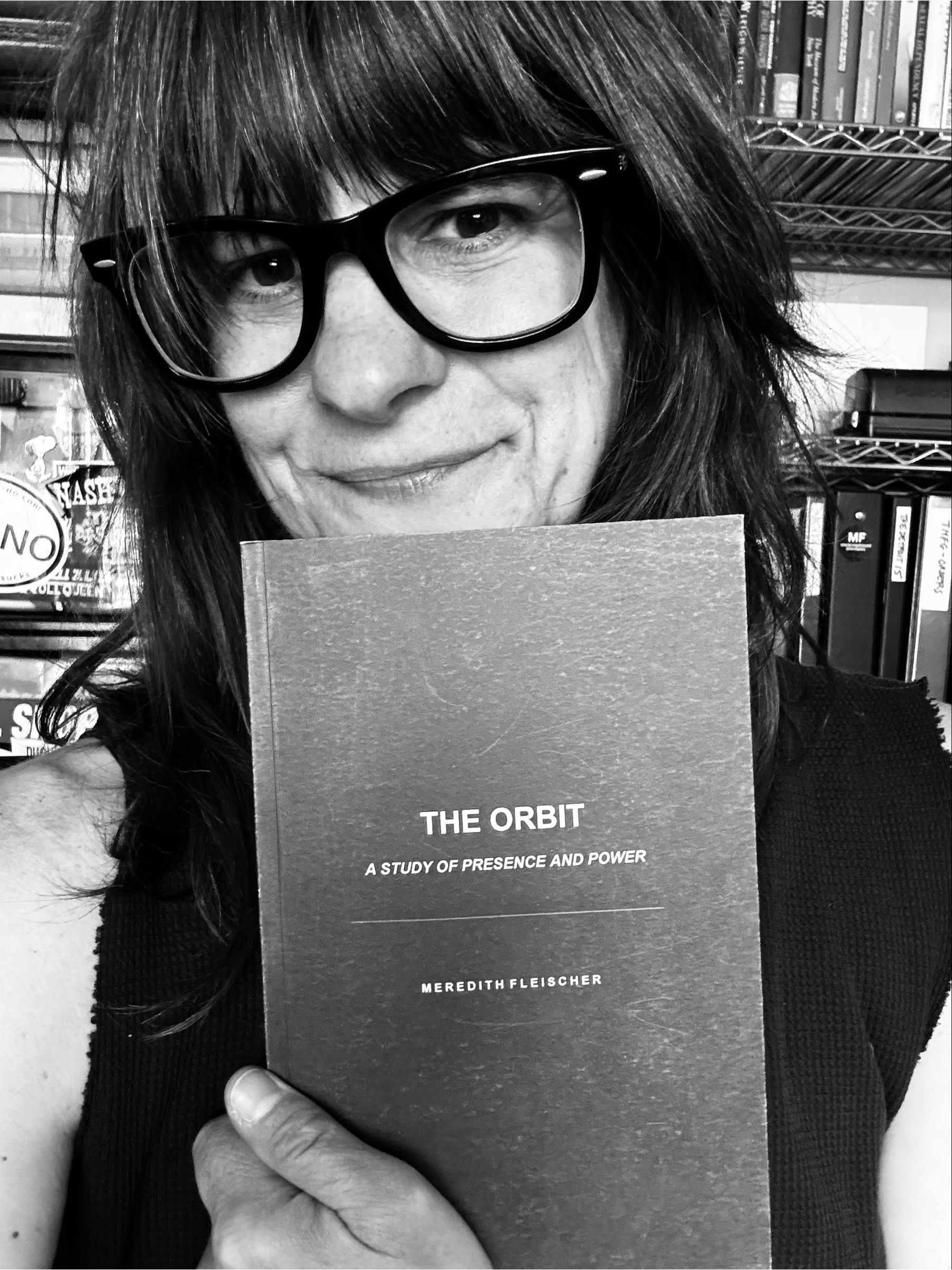
Portrait of Meredith Fleischer, 2026
Author Biography & Gallery Notes
Meredith Fleischer is the Founder and Director of The MF Gallery, an exhibition space and print shop specializing in street and documentary photography, celebrity portraiture, fashion and beauty, and music photography. The MF Gallery is the culmination of a career built within the high-intensity NYC photography landscape. Established in 2020 as a digital forensic archive and observation log, the project transitioned in 2022 into a sovereign e-commerce platform and representative body.
Fleischer holds an MFA from Cranbrook Academy of Art and a BFA from the College for Creative Studies, and spent her foundational years in the Art Departments of leading creative management firms. The gallery’s archival and curatorial program, titled the Detroit 15, serves as a high-fidelity platform and broadcast focused on the primacy of the original print, bridging the raw essence of modern masters with the live signal of contemporary photography.
She is the author of THE ORBIT: A Study of Presence and Power, a forensic nonfiction novella published in May 2026 as a limited first edition of 100 signed and numbered copies by The MF Gallery Publishing.
You can purchase the book and learn more about The MF Gallery at https://www.themfgallery.com.